
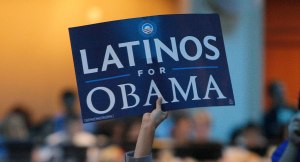
photo courtesy politico.com
Our nation is graced with millions of loyal, legal Hispanic Americans. They work hard, they raise beautiful families, and they vote – almost always for Democrats.
I recently talked politics with a couple of Mexican business acquaintances who both immigrated to the United States over twenty years ago, and was surprised at how similar our values and political leanings are. We agreed on every issue, right down the line. But when I asked them what they think of Republicans, or Conservatives, or the Tea Party, the fear and distrust was palpable.
You could say the Democrats have done an outstanding job of demonizing their Conservative opponents. Hispanic Americans are convinced that Conservatives are hateful racists who want to hurt them and hold them back in every way possible.
Apparently Hispanic Americans just don’t know what we Conservatives believe in and stand for. There can’t be any other explanation for the way they vote.
Here are five reasons why Hispanic Americans should vote for Conservatives and support our mission to downsize our over-reaching, destructive and unaffordable federal government.
1 – Conservatives want to improve the private economy and support businesses so that jobs are plentiful, pay rates improve, and families can enjoy a higher standard of living. That can’t happen when so much of our cash flows through a bloated, inefficient federal government. We think families should keep more of their earnings, and will make better spending decisions than the government can on their behalf. Millions of Hispanics came to this country for economic opportunity, and are willing to work hard to succeed. Why would they support Democrats whose policies have slashed personal income, exploded the national debt, reduced labor participation to record low levels, eliminated the middle class, and put one in five Americans on food stamps? If you want to be part of a thriving and growing economy, you are a Conservative.
2 – While Democrats work tirelessly to put more control and authority in the hands of the federal government, conservatives believe in personal freedom and responsibility. Most of our Hispanic immigrants came from countries with oppressive governments, where only those with connections or money have influence and opportunity. It makes no sense for them to support the party that pushes the United States toward socialism and heavy-handed government control. If you love opportunity and don’t want every detail of your life regulated by the government, you are a Conservative.
3 – Most Hispanic Americans have strong family and religious values. While Democrats fervently support the rights of Muslims, they find Christianity abhorrent, lashing out at any display of Christian faith with a vengeance. They have done all in their power to destroy the traditional family structure in our country. They promote gay marriage, endorse single motherhood through tax and welfare policy, and encourage abortion. If you treasure your family and your church, you are a conservative.
4 – Democrats are great at making promises, but somehow when they are in control, things seem to get worse. Is there anything the Democrats have done that has made life better for Hispanic Americans? For that matter, has any Socialist government in history improved the lives of its citizens? If you think the US Constitution and laws, and our rich history of defending freedom and truth are what made the United States the greatest and most prosperous nation on earth, you are a conservative.
5 – Fairness is important to all people, including Hispanic Americans. And nothing is fairer than being allowed to keep the property you worked for and to use it as it best serves you. Conservatives believe that our government should not try to seize or control our private property. And it should defend our property from those who would try to take it from us. My Hispanic American friends agree that our borders must be enforced, and we can’t provide benefits to those who only come here to take and not contribute. And our military forces must be ready and able to defend our homeland. If you want your property and the safety of your family to be secure, you are a conservative.
I know that most Hispanic Americans – and for that matter Native Americans, African Americans, Asian Americans, and traditional homeland-born Americans – are Conservatives at heart. We all want the same things. We just have to set aside political correctness and the Democrat agenda of deceit to find the higher common ground.
Tom Balek – Rockin’ On the Right Side

Powers keep on lyin’
While your people keep on dyin’
World keep on turnin’
‘Cause it won’t be too long

 I talk politics with friends, acquaintances, family, and even strangers, all the time. You probably do too. Many of these people have a growing sense that something is wrong, but they have not been engaged in politics or receiving real news and honest information about what’s going on.
 My wife and I are building a new home. We are doing some of the work ourselves but the majority of the work is done by subcontractors, mostly hired through our general contractor. Working on a major project like this brings many current political and economic issues from the big-picture level down to the up-close and personal level.
 There is, of course, physical labor to be done. For that the Saudis have imported legions of hungry, foreign workers from Africa and East Asia. An estimated 6.5 million foreign laborers toiled in Saudi Arabia a year ago, before rioting against inhumane treatment brought a government crackdown on illegal immigration and a slight reduction in their numbers. The few and vague immigration laws, however, are still not well-enforced.
 Every now and then I complain that the news media/liberal government is totally geared to our tiny little attention spans (the news media and liberal government are now inseparable and indistinguishable). They fully understand and exploit how soon we forget one earth-shaking news story when the next one comes along. We don’t care whether the last crisis was explained, let alone resolved. Instead we lurch ahead to the latest shocking crisis. And the news media/liberal government seemingly never runs out of crises. We’re so busy dealing with the latest crisis that we never take the time to look ahead.
 I don’t know about you, but sometimes when I watch the news I wonder what planet these talking head “experts” are from.
 So you went to the Lincoln-Reagan dinner and you wrote a check to the Republican Party. You thought your money would be spent to defeat liberal Democrats, right?
 Barbour’s propaganda campaign further claimed that McDaniel and the Tea Party would do away with food stamps and other benefit programs and cut funding for education, especially black colleges.
 My congressman, Mick Mulvaney (R-SC), frequently holds town hall meetings in his home district. Each meeting includes a half-hour presentation of current, relevant information and a one-hour question and answer period. Mulvaney tells his constituents what is on his mind, and then really listens to them. His responses are honest and direct, no evasion or weasel-words. He is knowledegable, articulate, engaged, and pragmatic.
 Tom Balek - Rockin' On The Right Side