Federal Employees – Here’s How to Get More Paid Vacation Time, Free!

vacationA message for Federal Government Employees:

Are you stressed out from all of those meetings and conferences in fancy hotels?  Is that 30-hour work week wearing you out? Five weeks of vacation couldn’t possibly be enough.  Couldn’t you use a little extra time off from that exhausting desk job?

How would you like an extra two weeks of paid vacation, free?  No tricks, no gimmicks, no downside!  No kidding!  Up to 14 days of extra paid vacation time!

It’s easy.  All you have to do is screw up!

That’s right, section 5 of the civil service code says that if you screw up, your boss can’t fire you.  In fact he or she can’t even recommend any kind of disciplinary action.  Your “punishment”, if any, will be determined by some middle-management guys in your agency who don’t have any skin in the game.  These “deciding authorities” have no interest in whether you follow the rules, break the law, embarrass your department, or threaten national security.  No skin off their noses, right?  They just need to be sure that their boss has plenty of CYA sauce, and that they don’t gum up the works.

If they give you any punishment at all, it will be paid leave.  Sorry, usually that is limited to 14 days, because if they assess more free vacation time than that, the “Merit Systems Protection Board” has to get involved, and it could complicate things for the boss. But don’t worry, really there is no risk.  Nobody EVER gets fired from the federal government in the Obama era.

Here’s how it works.  Let’s say you are on assignment for the DEA in Columbia, and you need a little extra time off (with pay) for a spring break getaway.  All you have to do is go hang out at the local brothel and have some fun with the working girls.  Really! Don’t worry, your sex party is paid for by the drug cartel (you know, those guys you have been pretending to bust for shipping container loads of cocaine to the fine citizens of Philadelphia and Detroit).  So go and enjoy your time off.  Your boss doesn’t mind.

The taxpayers don’t mind either.  Heck, they have been giving out paid leave for all kinds of federal employees who have learned that screwing up is the best way to get some extra paid vacation time.  According to the Washington Post, tens of thousands of federal employees are home on paid leave right now as part of their “disciplinary action” for screwing up.  Over a recent three year period the tab to the taxpayers was $775 million in salaries alone, not to mention the cost of replacing these bad boys and girls while they were on their extra paid vacations.

The taxpayers even pay government employees at retirement time for sick pay that they didn’t use because they didn’t get sick. What’s another couple of weeks of vacation for you?  No big deal.

So if you want a couple of weeks of extra vacation, take my advice:  do something terrible!

Tom Balek – Rockin’ On the Right Side

Rockin' On the Right Side


Vacation, all I ever wanted
Vacation, had to get away!

Vacation – the Go Go’s


We Must Demand Real Federal Budgets

zero based budgetingZero-Based Budgeting is a simple concept, practiced by every family and every company in the USA.  We all determine how much money we will receive for a given period, and then decide how we are going to spend it.  We give priority to necessities, and then, if funds are available, we may indulge in luxuries or less-important items.


In fact the practice is so simple, so obvious, so common-sense that we don’t even give it a thought.  We just do it.  Most Americans would be surprised to learn that our federal government, with the largest budget on planet Earth, does not.   The government simply takes whatever amount each department or agency spent last year, and adds to it.  It is a recipe for economic disaster, and our $18 trillion debt is exactly that.

Last month Rep. Dennis Ross (R-FL) introduced HR1591, the “Zero-Based Budgeting Ensures Responsible Oversight Act of 2015”.  ZERO for short.  It’s his third attempt to bring reason to our federal budget process.

The ZERO Act would require each department to justify all of its spending every year.  Congressman Ross points out that in recent years taxpayers paid $615,000 to digitize Grateful Dead tickets, $442,000 to study male prostitutes in Vietnam, and $2.5 million for a Super Bowl ad.  Neither you, nor I, nor any of our elected representatives authorized that spending.  But it happened because there is no oversight, and under the current “continuing resolution” system, there can’t be.

If ZERO is enacted, departments would have to describe every activity for which funding is requested, provide the legal basis for the activity, and offer three alternative funding levels, two of which would be below the current year’s level.  They would have to provide details on the benefits derived from each activity and any added benefit for increased funding.  Plus, they must show measures of cost efficiency and effectiveness.

Congressman Mick Mulvaney (R-SC) told me he and the budget committee “will take up zero-based budgeting as part of budget reform later this summer.”  So far only one congressman, David Jolly (R-FL) has co-sponsored HR1591.

At least three presidential candidates are advocates of Zero-Based Budgeting.  Two of them, Rick Perry and Jeb Bush, are governors who understand budgeting.  The third is Carly Fiorina, a dollar-savvy former CEO to whom ZBB is second nature.  Fiorina told Breitbart News about something I personally experienced as a small business owner:

“I started my career in Washington, D.C. and sold to the federal government. As anyone who has done business with the federal government knows, in the last six weeks of every year, every government agency spends every dime,” she continued. They do that because they want to make sure the appropriations process is focused on the rate of increase for the following year – not what they actually need or whether they actually need to spend it.”

We taxpayers are dropping the ball.  First of all, we don’t understand our own tax returns.  And second, we don’t do a good job of holding our elected officials and the bureaucrats they are supposed to oversee accountable for spending our money.

It is admittedly hard work to budget every year, and to actually plan and prioritize spending.  Families do it.  Businesses do it.  Is it too much to ask of our government officials and employees?  Let’s encourage our congressmen to get behind real budget reform.

This article can be seen in its entirety at Watchdog Arena.

Tom Balek – Rockin’ On the Right Side

Rockin' On the Right Side

What’s that honey?
Pick you up at eight?  And don’t be late?
But baby, I ain’t got NOOOOOOOO money, honey!
Oh, all right honey, you know what I like!

Chantilly Lace – the Big Bopper


Here’s a fun video about a guy with a budget problem:


Liquid Natural Gas – Good For Ecology and Economy

LNG tankWhat American product could . . .

The answer:  Liquefied Natural Gas (LNG).

The USA holds the potential to be the world’s energy leader.  The shale-oil boom that resulted from new fracking (hydraulic fracturing) technology has created a very happy unforeseen consequence:  a seemingly endless supply of natural gas, perhaps the cleanest, safest and most efficient energy source available.

When cooled to a temperature of -260 degrees Fahrenheit, natural gas becomes liquefied, and its volume shrinks by 600 times.  Traditionally, natural gas has been transported by pipelines.   The new LNG technology makes the shipment of natural gas practical and affordable, even overseas to energy-starved regions.  The efficacy of LNG for the production of electricity and automotive transportation applications is breathtaking.

It’s great news, and not only for the US economy.  Many nations, including Japan and China (the world’s largest energy importer), are in dire need of affordable and reliable sources of energy.  We have what they need.  So what prevents the USA from moving ahead and taking advantage of this narrowing window of opportunity?

Sadly, it is politics.  Not exactly partisan politics, but politics nonetheless.

Environmental activists like the Sierra Club oppose the extraction of virtually any fossil fuel, including natural gas.  They claim that increased demand for natural gas would encourage fracking, a practice they abhor.  They label anyone who defends the remarkable environmental accomplishments of the United States (in sharp contrast to China and other Asian nations) a “science denier.”  Yet it is these same environmentalists who fight the development of clean-burning natural gas and its export to the world’s worst polluters.

The Obama administration has done a balancing act in recent years, at times offering support for increased exports of LNG, and at other times acquiescing to pressure from its liberal base.

A lingering question about the benefit of exporting liquefied natural gas is the contention by some, including big players Alcoa and Dow Chemical, that domestic natural gas prices would increase if exports increased.  Numerous studies say it’s not true, and lately the Obama administration and the DOE seem to agree.

As I reported back in January of 2013, advocates of the export of LNG have been pressing the federal government to remove the roadblocks and get after it, before Russia and others beat us to the market.  Both the Dept. of Energy and the Federal Energy Regulatory Commission have imposed delays on the approval of LNG exports, invoking restrictions attributed to “impacts on health and the environment” and “economic, security, and domestic supply considerations”.  Cynics say well-funded lobbyists are in control.

In January the US House passed, on mostly partisan Republican support, a bill to speed up the approval process for LNG exports.  A similar bill was passed last year.  The likelihood of getting such legislation through the Senate and signed by the president seems slim.

If there is one issue that should have bipartisan support, it is the need for a new American energy policy.  The benefits of energy development, especially LNG, to our economy, employment, the environment, and national security are unassailable, the Sierra Club notwithstanding.   Pandering news reports and crocodile tears about climate change and science denial are nothing more than transparent demagoguery in the face of such an opportunity to really improve the economy and the environment simultaneously.

When “Earth Day” is celebrated later this month, I hope somebody brings up the subject of LNG – a game-changing technology whose time has come.

This post, and many more outstanding current and topical articles can be seen in its entirety at Watchdog Arena.

Tom Balek – Rockin’ On the Right Side

Rockin' On the Right Side

CLASSICAL GAS

My vote for the world’s greatest guitar player is Tommy Emmanual of Australia.  Watch this great video of him playing the timeless Mason Williams hit “Classical Gas”.

Here’s the video:

Mulvaney: Budget Committee to Push Zero-Based Budgeting

zero

see this article in its entirety at Watchdog Arena

There is no mystery to budgeting.  Whether you manage the finances for your family, your little league baseball team, or your business, you and everybody else in the private sector makes spending decisions the same way:  you determine how much money is available, and you set priorities for how to spend (or save) it.

Why is our federal government incapable of writing and managing a budget?

Those of us who live in the real world use a process called zero-based budgeting.  You may have never heard of the term.  It is such a common-sense approach that we all do it instinctively.  We categorize our spending into “needs” and “wants”.  Needs get priority.  We provide our families the necessary things like shelter and food before we start thinking about vacations, big screen televisions, and concert tickets.  If there are remaining “discretionary” funds, we decide how to spend or save them.

Unfortunately, that’s not the way that government – especially the federal government – thinks.

The way government has operated for many years, every department is entitled to the amount they spent last year, plus an increase.  Call it “continuing resolution”, “continuing appropriation”, or whatever – I call it flat-out laziness.  One of the primary responsibilities of our congress is to make sure that the funds taken from citizens are necessarily and appropriately spent.  Oversight of government spending should be priority one.  Unfortunately, it gets little, if any, attention from our elected officials, who spend their days pondering such weighty issues as whether the one tenth of one percent of the population who are sexually confused should get to choose which public bathroom they use.

You see, it is hard work to dig into the details of how each department and agency spends its money.  It’s much easier to just give each whatever amount they got last year, plus a kicker – because the employees probably deserve a raise, right?

Wouldn’t it be a refreshing change if congress did its job and started managing our money the way the rest of us do?

Maybe there is hope.  I asked my congressman, Mick Mulvaney (R-SC), who sits on the House Budget Committee, if there is any chance that the federal government might adopt zero-based budgeting.  I was surprised at his answer.  “I fully expect the House to pass budget reform this year, and that will include zero-based budgeting,” Mulvaney said.

This could be big.  Existing programs are never cut back, only increased.  And new programs require new funding.  Is it any wonder our national debt spirals out of sight?  Imagine our government agencies having to justify every program, every expenditure, every employee, every line item, on a yearly basis.  Just like businesses do.  Just like your family does.

“There is a chance it will pass and get signed,” Mulvaney said.  “The budget process is really, really boring but really, really important.  And it hasn’t been reformed since 1974.  It will be the biggest story you won’t hear much about in DC this year.”

Some political analysts advocate the “penny plan” as a budget-balancing measure.  The penny plan would cut one cent across the board from every dollar the federal government spends for five years, and then put a cap on national spending at 18% of GDP.  Mathematically it works, but it doesn’t address the fact that some spending is totally wasted, while not enough is allocated to other important work that taxpayers would support.  Cutting back on totally worthless programs while starving worthwhile ones is not good oversight.

Many programs, like the corrupt, obsolete Export-Import Bank, continue year after year with no justification other than inertia.  To this point, Congress hasn’t been able to muster the willpower to put these programs to bed even after they have long outlived their purposes, and they continue to stumble around like aimless zombies lost in timeless hell.  If every program had to justify its budget annually, we could quickly gain the upper hand over our exploding debt.

Here’s hoping the most important number in government this year is zero.

Tom Balek – Rockin’ On the Right Side

Rockin' On the Right SideMaybe I’ll win
Saved by zero.
Maybe I’ll win!
Saved by zero.

Saved By Zero – the Fixx


China Has ‘Net Neutrality’: Govt. Control of Internet Is Coming To America, Too

China ComputerIn a few weeks Congress will vote on a “net neutrality” bill that would turn significant control of the internet over to the federal government by allowing the FCC to regulate Internet Service Providers (ISPs) as public utilities.The bill is promoted using the same “class envy” technique that has been so politically successful over the years: “Just let us handle everything, and we will make sure internet access is ‘fair’.”  The legislation would, for example, prevent ISPs from charging some customers more than others for higher speed services, and from controlling access to certain internet content.  Sounds altruistic, doesn’t it?

History has proven that every time government takes a market segment away from the public sector, the product ultimately costs more, performs worse, is harder to get, and ends up profiting a select few well-connected cronies at taxpayer expense.

If the FCC takes control of our internet service, there is risk – perhaps likelihood – that competing ISPs will be pared down to a select few “winning” vendors.  Is it any wonder that Comcast, owner of the blatantly pro- big government news channel MSNBC, and one of the largest contributors to the Obama campaign, is a full-throated supporter of the net neutrality bill?  In these kinds of quid pro quo arrangements, make no mistake – the deep-pockets federal government trades cash for control. And the cash is non-partisan. Bill sponsors Fred Upton (R-MI) and Greg Walden (R-OR) received hefty contributions from AT&T, Comcast, Time Warner, and Verizon.

For a sneak preview of net neutrality, let’s take a look at internet life in the People’s Republic of China.  Regional ISPs in China are owned and operated by the government, who rigidly controls content as well as access to the internet.  The Communist party thwarted early attempts by its rival China Democracy Party to establish unrestricted internet access, enforced by arrests and imprisonment.   The Chinese government’s internet authority is documented in their “Computer Information Network and Internet Security, Protection, and Management Regulations”, approved by the State Council in 1997:

[to see the rest of my post please follow this link to Watchdog Arena]


Tom Balek – Rockin’ On the Right Side

Rockin' On the Right Side

K-12 Spending: more, More, MORE!

Education spending.  More is better, right?

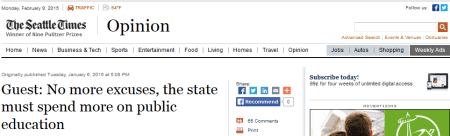
For years we have heard reports that teachers are forced to buy paper and supplies out of their own pockets, that some teachers qualify for food stamps, and that there have been “draconian cuts” to K-12 education budgets for decades.  Stories of the heartless underfunding of education are delivered with emotion and indignation, but seldom with statistical validation.

As student scores, college readiness and employability of graduates continue to decline across the U.S., the mantra of educators and progressives increases in volume and pitch.  “More money.  Just give us more money.  All we need is MORE MONEY!”

Seattle Times Headline Ed Spending

At a recent conference on school choice presented by the Franklin Center, Dr. Ben Scafidi shredded many of the myths about American taxpayers short-shrifting students.

Scafidi, director of the Economics of Education Policy Center at Georgia College and State University, said spending per student continues to increase sharply, studies prove that student achievement does not rise as a result of more spending, and there is no evidence that students are any harder to teach than they ever were due to non-school influences.

The most compelling finding of Scafidi’s 2012 study titled “The School Staffing Surge – Decades of Employment Growth in America’s Public Schools is this:

From 1950 to 2009 the number of students increased by 98%.  The number of teachers in public schools increased by 252%.  Meanwhile the number of administrators and other school staff increased by 702%.

Scafidi said, “If from 1992 to 2012 our public schools had increased non-teacher staff at the same rate that it increased teaching staff, it would have freed up $26.5 billion per year in education funds.  That could translate to an $8500 raise for every teacher, or a huge reduction in taxes, or scholarships that would allow many students to attend the schools of their choice.”

Opponents of school choice contend that students who remain in traditional public schools are harmed when budget dollars follow students to private or charter schools.  But Scafidi points out that charter and private schools operate so much more efficiently than the traditional public schools that fixed costs for the existing schools (about 36%) can still be covered by available funds and the remaining students in those schools benefit by the reduced variable costs.

Clearly there is no direct equivalency between dollars spent per student and results.  Test scores, graduation rates, and college matriculation at the private and charter schools I visited in Washington, DC were nothing short of miraculous compared to those of the traditional DC public schools, despite spending less than half the amount per student.

In previous posts I have reported school budgets in rural Montana schools of $22,000 per student per year.  While many of these students are getting a great education, by no means are they twice as smart as their city-school peers.  The cost is merely a function of declining numbers of students versus increasing costs, largely spending required by federal and state regulations and not the local school board.

I have personally seen many aggregious examples of non-academic school spending.  One Montana school district with 350 high school students keeps a stable of five cruiser buses, most equipped with personal video players, for their athletic and extracurricular teams.  Schools so small they can only play six-man football travel 350 miles to games.  My local school district in South Carolina just spent $6 million on artificial turf.  That’s got to affect the cost per student, without really improving student outcomes, wouldn’t you say?

Voters and taxpayers: next time you hear educators and progressives hollering for “more, more, more money!” you might ask how the extra dollars will be spent and how will students benefit.  Better yet, demand that the dollars coming from your hard earned pay can go with each student to the school of his or her choice.

Tom Balek – Rockin’ On the Right Side

Rockin' On the Right Side

And when you ask ’em, “How much should we give?”
Ooh, they only answer “More! More! More!”, y’all
It ain’t me, it ain’t me, I ain’t no millionaire’s son
It ain’t me, it ain’t me, I ain’t no fortunate one!

School Choice in DC – It’s Working

lion_gazelle posterMark Roberts, graying but still athletic in his crisp suit and tie, stood in the center of his circle of 15 students.  Every eye was on the articulate and energetic instructor as he probed their understanding of the character in their literature assignment, “Things Fall Apart” by Chinua Achebe.  The high school juniors bounced their thoughtful and mature-beyond-years analyses off the teacher and each other.  There was not a slacker in the room; each young scholar was as bright and engaged as the next.  And I thought, “I have never seen a high school class like this.”

Like most conservatives, I have always advocated school choice.  In my Adam Smith / free market / supply and demand worldview, whenever consumers have a choice the right products are delivered at the right cost, guided by the “invisible hand” of the marketplace.  Competition drives excellence in every aspect of life.  Why would education be any different?

Last week at Archbishop Carroll Catholic high school in Washington, DC I saw the proof of the theory firsthand.  Without question, these kids have very bright futures and a leg up on their public-school peers.  Maybe two legs, an arm, and a head.

Located in the middle of one of DC’s lowest-income neighborhoods, Archbishop Carroll has evolved over the years.  The aging but well-maintained facility was originally a boy’s school, one of the first segregated schools in DC.  Carroll later went co-ed, absorbed students from other Catholic schools, and in recent years has become a highly-sought educational alternative for families who want to extract their children from the grim, underperforming DC public schools.  While Catholic religious training is offered at Archbishop Carroll, it is not required, and only about 20% of the students take CCD.

Tuition at Archbishop Carroll is about $13,000 per year – far below the amount taxpayers spend annually to educate students at the failing non-charter DC public schools.  Many families pay the full tuition out-of-pocket.  In the interest of diversity, discounts are offered to white, Asian, and Latino students (the student body is almost entirely African-American), as well as registered Catholics.  Over half the students would not be able to afford to attend Archbishop Carroll without grants from the Opportunity Scholarship Program.

Archbishop Carroll competes with other private and charter schools for students by offering families a rigorous, no-nonsense academic program in a safe and uplifting environment.  With strong emphasis on accountability, discipline and character development, Carroll provides the education product and opportunity for future success that most parents want for their children.  But the competition doesn’t end there.

On a tour of the school organized by the Franklin Center as part of their “Amplify School Choice” conference, I asked student Wanofe Mideksa if she is a “superstar”, hand-picked to entertain us.  “Not really,” she explained.  “All the students here are high-achievers, because we have to compete to get into Carroll.”  Students are selected for admission by test scores, admission essays and interviews.  Once enrolled, they have to maintain their motivation levels.  Most students take public transportation, some traveling as long as an hour each way.  They wear jackets and ties, and dresses.  They are addressed as “Mr.” and “Miss”  and decorum is maintained at all times.  The school deliberately sets tuition just beyond the scholarship amount to ensure that every family has “skin in the game.”

And Archbishop Carroll competes for the best instructors.  “Our teachers don’t sit down during class,” said the school president, Mary Elizabeth Blaufuss.  “You won’t find them texting when they should be teaching.  They are here because they want to be part of a serious academic program.”

Education is no different from any other product or service.  When consumers have choices and suppliers have to offer the very best products to compete for their business, everybody wins.

Tom Balek – Rockin’ On the Right Side

Rockin' On the Right Side

Did you ever have to make up your mind?
You pick up on one and leave the other one behind
It’s not often easy and not often kind
Did you ever have to make up your mind?

Did You Ever Have to Make Up Your Mind?  – The Lovin’ Spoonful


A Conservative Thankful for . . . Government Employees?

Thankful TurkeyYes, I am a conservative, and on this Thanksgiving holiday I’m thankful for government employees.

Now, before you choke on your turkey giblet stuffing – let me explain.  There are many things that government does extremely well.  When I turn the tap at my sink, I get clean, safe water every time.  And the cost of it is pretty darned reasonable.  My garbage gets picked up right on time.  The stop lights work, our streets and highways are pretty good, and if there is an emergency the fire, police and EMS/rescue guys are top notch.

I generally don’t worry about our country being pushed around by other nations because our military is still the biggest, baddest dawg in the junkyard.

We need good government employees and the services they provide that we just can’t do as individuals.  I believe for the most part our local and state governments do what is expected of them and at a cost we can manage.   I just wish the same were true of the federal government.

It’s not that the federal government doesn’t do enough for us.  Quite the contrary, it does way the hell too much.

Most Americans don’t understand that our Constitution limits the authority of the federal government to a fairly short list of “enumerated powers“.   The first item in the list says:

The Congress shall have Power to lay and collect Taxes, Duties, Imposts and Excises, to pay the Debts and provide for the common Defense and general Welfare of the United States

The remaining items on the list mostly refer to national defense, currency, and post offices.  And anything not specifically on that list, according to the Tenth Amendment,  is strictly off-limits to the feds.

“The powers not delegated to the United States by the Constitution, nor prohibited by it to the States, are reserved to the States respectively, or to the people.”

There is nothing in the enumerated powers that allows the federal government to redistribute income or to compensate anyone for financial loss or misfortune.  You won’t find any reference to endangered species, or global warming.  Nothing there about foreign aid.  No mention of education.  The feds aren’t authorized to provide bailouts of private companies, banks, or mortgage-holders.  They aren’t supposed to be buying up private land and property.

In fact, most of what our federal government does is not authorized by the Constitution.  Maybe that’s why our current administration — cheered on by the media, academia, and a good portion of our nation’s under-educated and disengaged citizens — doesn’t feel it should be restricted by Constitutional law.

Sometimes we conservatives are mischaracterized as “anti-government” zealots.  Contrary to liberal claims, we don’t want our children to drink dirty water, our disabled to die in poverty on the streets, or our grandmas to be pushed over a cliff when they pass the age of usefulness.

Just the same, we aren’t pleased when our federal government takes our hard-earned money – our property – by force and gives it to another person, company, or nation for motives we don’t support, and purposes that are not constitutional.  And we wonder how awesome life in America would be if our federal government was the lean, mean machine the framers of our Constitution intended – protecting the borders, providing national defense, and doing only what it is supposed to – without the incredible waste of resources and failed social experimentation that holds us back.

It’s true we are abused by a growing number of (mostly federal) unaccountable bureaucrats who never answer the phone.  But most of our government employees are just out there doing the honorable work of the People, and they deserve a thank-you.

Tom Balek – Rockin’ On the Right Side

Rockin' On the Right Side

You didn’t have to love me like you did
But you did, but you did – and I thank you
You didn’t have to hold me like you did
But you did, but you did – and I thank you

No Earmarks! Never Going Back There Again!

“As long as I’m the Speaker, there will be no earmarks.” – Speaker of the House John Boehner – July 2014

Boehner is still Speaker, having been re-elected to the post for the third time by his members last week.

Believe it or not, many members of Congress, including Republicans, have been pushing for some time to end the ban on earmarks which was put in place in March of 2010.  Senator Harry Reid pressed for reinstatement of the earmark privilege last summer, saying, ” I am proud of all the earmarks I have gotten for the state of Nevada. They’ll come back — it’s only a question of time because that’s our constitutional obligation.”

An amendment to roll back the moratorium on earmarks, led by Rep. Mike Rogers (R-AL), was brought to a House vote last Friday, and failed by a 2.5 to 1 margin.

Good.  Apparently they get it.

Earmarks represent everything that is ugly about DC politics.  “Bringing Home the Bacon” is largely responsible for our $17 trillion debt.  Control over earmark awards has been a weapon used by house leadership in the past to bludgeon members into line.  One of the more infamous recent earmarks was the $223 million “Bridge to Nowhere,” which cost Alaska congressman Ted Stevens his political career.  “Material Girl” Nancy Pelosi steered hundreds of millions of dollars to her home district via earmarks.

Senator Tom Coburn has been a long-time opponent of pork-barrel spending and especially the use of earmarks, calling it the “gateway drug to Washington’s spending addiction.”

The “wave” election of 2014 places a heavy responsibility on Republicans to restore fiscal sanity to our federal government.  That even a few Republicans considered eliminating the ban on earmark spending is disappointing.  Let’s not go there again.

Tom Balek – Rockin’ On the Right Side

Rockin' On the Right SideYou don’t know what it means to win
Come down and see me again
Been down one time
Been down two times
I’m never going back again

Never Going Back Again – Lyndsey Buckingham

Cool live version of a Fleetwood Mac classic!


Marketplace Fairness Act – Just Another New Tax

tax key on keyboard

image by ConservativeActionAlerts.com

Internet-based companies are always looking for a new revenue stream on the web.  Unfortunately, so are federal and state governments.

One way the government could profit from internet traffic would be to charge a tax for internet access.  A moratorium currently prevents taxation of internet access, but that will expire on December 11 if it isn’t extended.

Another way would be to collect more sales taxes on internet sales.  Currently only businesses who have a physical presence in a state are required to charge sales taxes for orders from customers in that state.

A bill called the “Marketplace Fairness Act” passed the Senate last spring.  It would enable a state to collect sales taxes on all internet purchases shipped to its citizens and companies from other states.  Fortunately, the House chose to ignore the Senate bill, but the Senate hasn’t given up yet.

Senator Mike Enzi (R-WY) wrote a bill that would implement the Internet Sales Tax, and in exchange would outlaw internet access taxes for ten years.  (See why I was so excited that Liz Cheney was going to run against Enzi?)  The Senate hopes to pass the bill during the upcoming “lame duck” session.  If the bill doesn’t pass, internet users well might find new tax charges on their monthly web access and smart phone invoices.  It’s the perfect crime – if you don’t let us raise this tax, we will raise the other tax!

A true free market is eminently fair, where anyone can compete on an even playing field.  Some say it is unfair that brick-and-mortar businesses have to collect sales tax from their customers while internet sellers can ship the same products to the same customers tax-free.  It would clearly be unfair to require one business in a state to charge sales tax and exempt another business in the same state.  But is it fair to impose one state’s tax laws on people and businesses in a different state?

I owned and operated a small retail business in Montana for ten years when the web was really taking off, and I heard a lot of whining by store owners about competition from internet dealers.  “Not fair,” they howled.  “We can’t compete with the internet companies.  They don’t have to provide advice or service to the customers so their prices are lower.  They can run a business out of a basement in their pajamas.”  Sales tax didn’t enter into the conversation in my state, because Montana has no sales tax, but I’m sure it was a whining point in other states.

I heard the complaints, but it all seemed perfectly fair to me.  The internet dealer offers customers an alternative to the traditional brick-and-mortar store.  The web seller has lower prices, broader selection, and unlimited shopping hours.  But the store down the street offers immediate availability, personal service and advice, and you get to see and touch the merchandise before you buy it.  Plus your local store is a citizen of the community who supports charities and schools and pays local taxes.

Some weaker small businesses just folded up.  The smarter ones built their own web presences, found new revenue opportunities online, and trumpeted the advantages their stores offered over web competitors.  It’s a tough game, but fair.

This issue is being played as if it were about fairness and leveling the playing field.  Horse hockey.  It’s about raising taxes.

Instead of laying awake nights trying to figure out how to raise more taxes, why don’t you guys inside the beltway think about reducing the size of government and cutting back on all the crazy spending?

Note to self:  call my representatives and senators, and strongly suggest that they support permanently extending the internet access tax moratorium and KILLING the internet sales tax.

Tom Balek – Rockin’ On the Right Side

Rockin' On the Right Side

I feel so good come payday
I think of all the things I’m gonna buy when I pick up my pay

Don’t you know, but then they hand me
That little brown envelope
I peep inside, Lord I lose all hope

‘Cause from those total wages earned
Down to that net amount that’s due
I feel the painful sense of loss between the two

Johnny Cash – After Taxes