Once he was the strongest man in the world, respected and relied upon by the hungry and oppressed. Now he is an old man, weak and frail, with medical problems too numerous and serious to list.
In recent years, Uncle Sam’s immune system has broken down to the point of total failure. It is now unable to prevent alien organisms from invading his body at will, to the extent that Sam’s appearance has even changed. He no longer resembles the man he once was.
Once the strongest man in the world, Uncle Sam is now a sissy, preferring girl’s clothing and makeup to the fit athleticism and bold, masculine confidence of his youth. He is now the favorite target of bullies, who no longer hesitate to take his lunch money.
Most distressing of all, poor old Uncle Sam suffers dementia. He thinks anyone can choose and change their genders, and that deviant sex, even for kids, is a good thing. He believes he can spend unlimited amounts of money without ever running out. He even thinks that national elections will be perfectly administered even if there are no rules. His brain is so addled that it seems nothing is too preposterous for him to believe.
Not so long ago Uncle Sam was clear-eyed, honest, devout and dedicated to the protection of his family. How much longer can he withstand the ravages of the diseases his current caregivers have foisted upon him?
I’m afraid the only thing that will save Uncle Sam is a new doctor.
Tom Balek, Rockin’ On the Right Side
‘Cause I have wandered through this world And as each moment has unfurled I’ve been waiting to awaken from these dreams
People go just where they will I never noticed them until I got this feeling That it’s later than it seems
Doctor, my eyes Tell me what you see I hear their cries Just say if it’s too late for me
We took a short vacation trip to the Outer Banks of North Carolina last week. Cool place. But it seems I just can’t go anywhere these days without getting a bad case of government-itis.
For my friends up north, the Outer Banks is a long, narrow strip of sand (peninsulas and islands) on the east coast of North Carolina, with the Atlantic Ocean to the east and river inlets to the west. It is windy, mostly barren, and full of character, featuring eclectic art shops, t-shirts, beach houses, and fabulous seafood restaurants, wrapped up in a laid-back sea-life groove. Not pretty, but cool.
Anyway, driving south from the civilized part of the OBX, we soon realized we were no longer on privately-owned sand. The signs (‘Don’t Do This!’ ‘Do That!’ ‘Prohibited!’ ‘No!’ ‘Stop!’ ‘Don’t Even Think About It!’) were a dead giveaway. We had landed on federal U.S. Park Service turf.
My wife is a lighthouse nut, so we followed the Park Service “Do This” and “Don’t Do That” signs to the Bodie Island Lighthouse parking area and set out across the grass to enjoy the view. There we ran into a friendly-looking man in a crisp brown Park Service uniform, greeting visitors to the lighthouse. I’ll call him Mr. Friendly.
We wanted to climb the stairs to see the view and the internals of the lighthouse. But, unfortunately, it was closed to the public for another week or so. Mr. Friendly did not know why the government had closed the lighthouse. But we thought since we were there we should at least learn something about this interesting and still-operating historical landmark.
“How tall is it?” I asked. Mr. Friendly frowned. “Gee, I don’t know. I heard somebody say something about 160, would that be feet? Does that make sense?” he said.
“Well, ” I pressed, “when was it built?” Again, Mr. Friendly apologized. “I’m sorry, I just don’t know very much about this place. I guess I should get a pamphlet or something. You see, I’ve only been here since Thanksgiving.”
Hmm, Thanksgiving was almost five months ago. My wife and I looked at each other, eyebrows raised with the same unspoken question: What the hell has Mr. Friendly been doing for the last five months?
We asked him where he was stationed before his post on the Outer Banks. “Oh, I was in Wyoming!” he beamed. Being from Montana, we are pretty familiar with Yellowstone Park, and asked him where he lived. He said he had five houses while he was assigned to Yellowstone, the last one in Gardner, Montana. Again, we glanced a knowing look at each other. Several BLM and Park Service employees had told us over the years about the policy that allows management employees to transfer anywhere they wished, at any time, with all expenses paid. Usually the feds even purchase the employee’s home (with taxpayer money) to make sure there is no hardship of any kind related to the transfer.
We left the Bodie Island lighthouse suffering early government-itis symptoms and headed for the next lighthouse (there’s really not much else to see) at Cape Hatteras.
Again we wove our truck through the Do and Don’t signs. Again we were not allowed to go up in the lighthouse. And again we were greeted by a friendly man in a crisp brown uniform. But this guy knew his stuff! He was loaded with all kinds of interesting and amusing facts and anecdotes about his lighthouse, and shipwrecks, and German U-Boats. He attracted a big crowd of fascinated tourists and was happy as a clam to stand in the hot sun and talk with visitors all day. In fact, he told us he hardly ever takes a day off. In the world of tourist guides, this guy is Mr. Rockstar!
Then we noticed Mr. Rockstar’s name badge, which revealed that he is a volunteer.
We went into the small museum adjacent to the lighthouse, and passed two surly-looking women seated at empty desks in their crisp brown uniforms with government-employee badges. I backtracked around several “Don’t” signs and greeted one on the way out. “Hey, your guide out front is doing a great job,” I reported. “Hmmph,” Mrs. Crabby snorted. “He’s new, he doesn’t know anything.” She turned to the other surly government employee and they quietly hissed to each other, making furtive glances out the door at Mr. Rockstar, who was blissfully entertaining a large and smiling group of tourists.


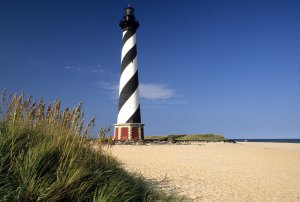 We took a short vacation trip to the Outer Banks of North Carolina last week. Cool place. But it seems I just can’t go anywhere these days without getting a bad case of government-itis.
 Tom Balek - Rockin' On The Right Side