Profit! What a Concept!

GoodJobI recently visited with a high school “job coach”.  This instructor works with local businesses who provide part-time jobs for students to give them an introduction to the working world.  Many years ago as a high school business teacher I had a similar program – back then it was called “distributive education.”  I found it to be a great learning experience for my students, and some moved right into good jobs with their sponsor employers upon graduation.

I asked the job coach what kind of preparation the student receives before embarking on the job.  It was not a trick question, but the teacher was caught by surprise, and really didn’t have an answer.   I admitted that my recent experience with school jobs programs as an employer had not been very enjoyable.  The student-workers I was assigned were arrogant, lazy, and not really interested in learning anything.  It may have just been the luck of the draw.  I did my best to get them on track.

At the end of our visit, I offered a suggestion to the instructor.  Having been on both ends of the equation – as an employer and a job coach – I think the most important wisdom one can impart to a student, or any job seeker, is an understanding of why a business exists.   Most students (and adults for that matter) when asked “why is that grocery store there?” will answer “because we need food.”

And there lies the problem. 

I gave my new job coach friend the correct answer:  that grocery store exists to make a profit for its owner or investors, who seek to feed their families and improve their standards of living.

It’s a subtle, but important distinction.  Yes, we need food.  But that doesn’t mean someone else is required to give it to us.  Free markets only work when each of us offers something of value to someone else.  We must all be producers of wealth or added value.  Those who succeed understand this concept clearly.  Want to make $5 million a year throwing a baseball?  You had better be good enough that people will fork over big bucks to watch you.  Do you want to own a business?  You’ll do great as long as you offer what a customer wants to buy, at the right price.

Do you want to have a job?  Then you had better understand that the only reason someone else will pay you is if you help them make a profit.

And that was my suggestion to the job coach.  “Make sure your student goes to the job with the knowledge that his or her purpose is to make money for the employer.  And that employers share their profit with their employees – the more you contribute to profit, the more you will be rewarded.  The employer owes you nothing, but he is always looking for somebody who will help him make money.  When you both are making more money, and spending it, the economy grows and everybody does well.”

A light bulb lit above the job coach’s head.  “Why, I never thought of that!  What a great idea!”

Yes, it’s a great idea.  It used to be what made the world go around.  Some may think it’s “old school”, but I’ll put my money on free enterprise, supply and demand any day of the week.

Tom Balek – Rockin’ On the Right Side

Rockin' On the Right Side
Big Time, I’m on my way, I’m making it,
Big Time, I’ve got to make it show yeah!
Big Time, so much larger than life,
Big Time, I’m gonna watch it growing!
Big Time, my car is getting bigger!
Big Time, my house is getting bigger!

Big Time – Peter Gabriel

One of the quirkiest, and most popular, videos ever!

Canada and Mexico: Hey, Remember Us?

north-america-mapHere is today’s current events quiz:

  1. Who is the political leader of the largest exporter of oil to the United States?
  2. Who is the political leader of the second largest exporter of oil to the United States?
  3. Which nations are the top two importers of U.S. goods?

Answers:

  1. Yesterday Enrique Pena Nieto was inaugurated as president of Mexico.  He promises to create jobs and fight poverty in a nation that suffered 60,000 violent deaths and crushing corruption during the six year term of his predecessor, Felipe Calderon.  Some say he is just another insider and not much will change.  Have you heard anything about our southern neighbor in our mainstream media or from any of our own political leaders?
  2. Stephen Harper was elected prime minister of Canada in 2006 and is now serving his second term.  An advocate of individual freedoms and government accountability, Harper’s administration enjoyed considerable fiscal success early in his presidency, but lately Canada has been held back by the slowdown in the U.S. and world economies.  How many times has President Obama met with the leader of our northern neighbor and largest import customer?  I can’t find reference to more than one meeting between the two.
  3. See numbers one and two above.

Few Americans know the answers to these questions because WE GET NO REAL NEWS.  And because WE HAVE NO REAL POLITICAL LEADERSHIP.

I am embarrassed every time I visit Canada and find that my friends from the Great White North know infinitely more about what’s going on in our country than we do about theirs.  Actually, they seem to know more about our government and events than most Americans do.

Recently a friend from Australia lamented to me that he and his wife drove around the United States for ten weeks this summer and never heard a single word about his home country in the news.

If this is how we treat our best friends, is it any wonder we have so few of them?  And that those we have are lukewarm, at best?

Earlier this week I railed about our critically injured sense of priorities. What should the top priorities of our President be?  He seems to spend most of his time campaigning, either for election or in support of his “tax the rich” non-solution to our economic woes. He engages in small social issues that affect very few Americans and don’t address the thundering herd of elephants in the room – unemployment, debt, and runaway government spending.  His priorities are climate change, fairness, and social engineering.

A true leader would be learning about, supporting, and working hand-in-hand with our North American friends and neighbors.  We should forge a regional alliance to take advantage of our human and natural resources to compete economically with China and Europe.  We should stand side-by-side before the world in support of human rights.  And for God’s sake, why aren’t we helping Mexico become the thriving democracy it should be – not only for our own economic well-being and security, but because it’s the right thing to do for a neighbor and friend?

I’m afraid our friends have, rightfully, lost confidence in us.  It’s time for all Americans to demand that our political leaders reset their priorities.

Tom Balek – Rockin’ On the Right Side

Rockin' On the Right Side
As you walk on by, will you call my name?
Or will you walk away?  Will you walk on by?
Come on – call my name. Will you call my name?

Don’t You Forget About Me – Simple Minds

There Is No “Candy Man”

prioritiesThese days we often seem to bounce around in life’s pin-ball machine, feeling that much around us is out of control.   We are distracted by a barrage of information as the media pulls us this way and that.  Generally, whichever news story has the hottest video footage or the most startling sound byte is pumped up to become the “important” story of the day, or the week.  Example: Sandra Fluke and her birth control.

I’m as guilty as anybody else.  I get upset and pumped up over things that are insignificant, both on a personal scale and in the bigger scheme of things.  When I find myself getting a little over-wound, I find it helpful to do a personal priority check.  What are the most important things to me, and in what order?

My top priorities always pertain to my family.  Are we healthy?  Are we safe from physical harm?  Are we financially okay?  Are we generally happy and fulfilled?  Are we preparing for our future?

Our brilliant founding fathers established a government that is “of” the people, and that carries responsibility.  It is our duty as citizens to prioritize the makeup and the work of our government.  Maybe it’s time we do a government priority check.  What are the most important things that our government should do, and in what order?

I look at government the same way I do insurance. I see government as a way that I can spend a portion of my personal resources to do the things I can’t do by myself.  Individually I can’t defend the borders of my neighborhood, much less my state or nation.  But I am willing to join other citizens to give some of my time or money for that purpose, because it is a priority for my family.  I can’t build a highway.  I can’t put out a big fire.  I can’t do brain surgery.  You get the picture.

Of course I can only spend a portion of my time and money on these shared priorities, because I have my own personal priorities to attend to.  So my government priority list is fairly short.   Our brilliant founding fathers had a short list too; it’s called the Constitution.

Lately I find that many of my government’s top priorities are way down my family priority list, or not on my list at all.   Our leaders operate like the “Candy Man”.  They believe they can keep adding benefits to those already in place, without limit, and without having to prioritize.  Irresponsible voters endorse that fantasy, but realists know it can’t go on.

It’s time for a good, hard look at priorities.  Our own personal priorities come first, of course, and our government priorities are an extension of that.  As we consider each government activity at our schools, our city and county commissions, our state and federal governments – as we consider the “Fiscal Cliff” – we must compare our government’s priorities with our own family priority lists.  If they don’t match up, we owe it to our families to do something about it.

Tom Balek – Rockin’ On the Right Side

Rockin' On the Right Side
The government takes everything we make
To pay for all of their solutions
Health care, climate change, pollution,
Throw away the Constitution!
The Government Can – Tim Hawkins

EPA Puts Bicyclists On Endangered Species List

I pulled out of the Costco parking lot in Helena and stopped at the stoplight.

“Geez,” I exclaimed to my wife.  “Look at all the painted lines through this intersection.”  Cars whizzed by left and right as we waited out the light, blinking and screeching and zooming through at the last second, or even a little late.   It was barely-organized chaos.  I looked to my left, and there was a narrow lane with a bicycle icon – RUNNING RIGHT THROUGH THE MIDDLE OF A SIX-BY-SIX LANE BUSY INTERSECTION.

I was startled.  I tried to picture riding a bike through that mess.  Heck, driving a car through there is practically suicidal.  What kind of moron would take that chance on a bike?  For that matter, what kind of moron designed the bike lane?  And how many days of the year can you ride a bike in Helena, anyway?

Welcome to the crazy world of AGENDA 21, under the innocuous title “Complete Streets”.  It has taken root in most cities in Montana and across the country.

While you were asleep, or watching football, or shopping, your city leaders were feverishly studying the Agenda 21 and ICLEI guidelines set out by the United Nations and a worldwide network of socialists.   They don’t really know why they are doing this, but they have to keep the promises they made in exchange for a couple thousand bucks from George Soros.

Agenda 21 is a very ambitious and complicated plan.  Think “We Can Change the World”.  The main goal is “social justice”, where rich nations give their money to poor nations:

All states and all people shall cooperate in the essential task of eradicating poverty as an indispensable requirement for sustainable development, in order to decrease the disparities in standards of living and better meet the needs of the majority of the people of the world. – (Agenda 21 – Principle 5)

In order to make more of our wealth available to transfer to the poor nations, we rich nations need to cut back on extravagances, like driving around in cars. That’s where “Complete Streets” comes in. If we ride bikes instead of driving cars, then we will have left-over money to send to the Congo so they can drive cars. Plus, we will create less pollution, so that all the new cars in China won’t need expensive smog controls.

As a Montanan, it’s hard for me to understand the merits of these crazy bike lanes.  So I put on my Socialist Cap and tried thinking “globally.”

I considered that if more bike riders are killed, it reduces the pressure humans are putting on Mother Earth.  Yeah, that’s it!  That’s why we need bike lanes!

But wait, that would reduce the number of Democrat voters.  Hmmm.

I’ll have to think about this some more.

Tom Balek – Rockin’ On the Right Side

There’s too many ahead of me
They’re all tryin’ to get in front of me
I thought I could find a clear road ahead
But I found stoplights instead

Expressway To Your Heart – the Soul Survivors

Looking For Benefits?

For some time now, President Obama and his PR department (the mainstream media) have contended that our nation’s biggest problem is inequality.  Not unemployment, not lack of GDP growth, not the national debt and deficit, not the growing number of people on food stamps and other government assistance.  The most important problem, according to them, is the gap between the rich and the poor.

Defining rich and poor is subjective and difficult.  Most often lately, “rich” has been defined as a couple who earns more than $250,000 per year.   Presumably the threshold is lower for singles.

“Poor” is almost never really quantified.   Some of us are old enough to remember the television ads showing skinny Appalachian kids leaning on stick-built porches, wearing rags and sad faces.  I’m not saying those were the good old days, but times have sure changed.  Kids on food stamps today are, as often as not, obese.   Recipients of federal disability payments has increased by 50% in the last ten years.  Since January 2009, the number of individuals on food stamps has skyrocketed from 31.9 million to the current record high 47.1 million. By comparison, in 1969 just 2.8 million Americans received food stamps.

If you are reading this, I’m pretty sure you have never seen the federal government’s “Benefits” website (see graphic above).   The banner headline is:  “Looking For Benefits?”  Apparently plenty of people are – 70% of federal spending in 2010 went to “dependence-creating” programs, compared to 28% in 1962.  Our Secretary of “Labor” (see Hilda Solis’ statement above) now promotes benefits, not labor.

According to the 2012 Index of Dependence on Government:

The great and calamitous fiscal trends of our time—dependence on government by an increasing portion of the American population, and soaring debt that threatens the financial integrity of the economy—worsened yet again in 2010 and 2011. The United States has long reached the point at which it must reverse the direction of both trends or face economic and social collapse.

Programs considered “dependency-creating” are federally paid housing, health care and welfare, retirement, federal payments for higher education, and agricultural subsidies.  One could argue that retirement is not a benefit, because it is supposedly self-funded.  Or that agricultural subsidies are not a benefit – but much of that budget is food stamps, and the rest is mainly farm subsidies to large corporations, both of which cause dependency.  I can think of other spending that creates dependency too, like corporate bailouts and other government investments in chosen industries. In any event, we are looking at the same spending categories from 1962 to 2010 – and they jumped from 28% of the budget to 70%.

We can argue until the subsidized cows come home about what is fair, or whether taking property from one American to give it to another is even constitutional.

But anyone who thinks we can continue our current spending habits, or continue to encourage the use of government benefits – regardless of how much tax is paid by the “rich” –  is dangerously ignorant.

Tom Balek – Rockin’ On the Right Side

I hope you hear inside my voice of sorrow
And that it motivates you to make a better tomorrow
This place is cruel no where could be much colder
If we don’t change the world will soon be over
Living just enough, just enough for the city.

Living For the City – Stevie Wonder

“US Government, Sorry I’m Not Able to Take Your Call”

When any organization gets too big it becomes hard to manage.

That doesn’t mean it can’t be managed.  Many huge companies are very well run.  Most people would agree that our military sets a high bar for disciplined management.  Operationally, at least.

Why is our federal government such a disorganized, inefficient mess?  What is lacking in the federal government world that other large organizations seem to have in abundance?

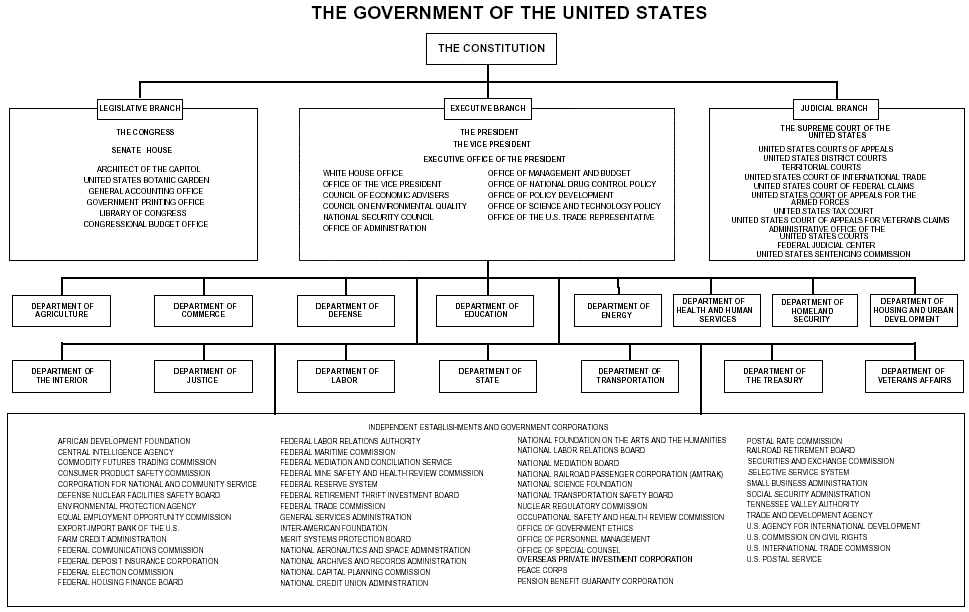
We do have organizational charts for our federal government.  There is an interactive one online.  Here’s the short version (click to enlarge):

The full version with all of the departments and all 3 million federal employees would probably cover the floor of Cowboys Stadium in a 12-point font. Of course within a nano-second, it would be obsolete.

Most Americans would expect to see our President in the top box.  After all, he has been known to say “the buck stops here,” even while pointing fingers in every direction and blaming historical figures for the nation’s problems.

The official federal org chart has “the Constitution” in the top box.  It would make more sense to me with “We the People” at the top.   We can hire and fire all those below us on the chart.  We can hold the President, the Congress, and (through appointments) the Supreme Court accountable.  It is up to us, as voters, to make sure that everyone in the federal government is doing what we want them to do.

But we citizens don’t agree on much of anything.  Many of us don’t really care how our government operates.  And even if we did, the organization is so huge that we have to rely on layers and layers of managers who we don’t know and will never see.

Is there anything we can do?  Where do we “citizen managers” start?

I think the first thing we should do is check to see who is at work.  Here is my plan, and I would like you to join me.

Go to www.usa.gov and pick out five federal government employees.  It’s really easy to follow the links through the website to identify agencies and administrators at every level.  You might choose agencies in your hometown, or an office in which you are interested.  Or maybe you will just pick names and phone numbers at random.

At 2:30 on any weekday afternoon, or at 1:00 on a Friday, call the people on your list to see who is at work, and who is taking the rest of the day off.

In the unlikely event the federal employee you are calling actually answers the phone, say “Hi, I’m a taxpayer, and I’m just calling to make sure you are on the job.  Thank you!”

If not, leave a message of your choice, maybe something like:  “Hi, I’m your boss, a taxpayer; it’s 2:30 pm and you should be working.  I am going to follow up with your supervisor.”

Here are my random calls at 2:30 this Tuesday afternoon:

  • Rosanna Goodwill – Acting Director of Civil Rights, Federal Railroad Administration:  recording said she is “away from her desk, leave a message.”
  • Neil Moyer – Acting Director of Office of Policy, Federal Railroad Administration:  recording said he is “not available right now, leave a message.”
  • Don E. Watson – Historically Black College and University Capital Financing Advisory Board:  recording said he is “not available to take your call, leave a message.”  I wanted to ask him why we need his agency.

I left messages for each, expressing my disappointment that nobody in federal government is at work this afternoon.

I will allow that there are times when someone is legitimately not able to answer a call.  But I’ll bet the answer rate is under 10% after 2:00 every afternoon.  I have tried this experiment many times, and have never had my call answered.  Not once.

I don’t know if our government employees care if we catch them slacking.  If nobody ever checks on them, they might start to wonder if it matters whether they are there at all.   Anyway, we are the bosses, and we should make at least the minimum effort to supervise our employees.   Please make some calls!

Tom Balek – Rockin’ On the Right Side

Okay. So no one’s answering.
Well can’t you just let it ring a little longer, longer, longer, ohhhhh!
I’ll just sit tight, through shadows of the night.
And let it ring for evermore.  Yeah, yeah, yeah.

Telephone Line – Electric Light Orchestra

Obama’s Data Mining Wizards

Nothing goes unnoticed by the data miners these days.  They know all about you.  They know what you like to buy, and when.  Every website you see, every search you execute, every TV show you watch is recorded. They know your age,  your political persuasion, your address, and a lot of other things you would never suspect.

Did you show your “preferred shopper” card on that last trip to the grocery store?  They used it to figure out what you might want to buy next time, and how to encourage you to spend more.  (I often express my sticker shock – “Wow, I’m glad I’m a preferred shopper!  I’d hate to see what you do to the customers you don’t prefer!)

The Obama campaign took masterful, full advantage of data mining, and some think it is what won the election for them.   Instead of relying on traditional political advisers and old-school marketing experts, Obama played the campaign game strictly by the metrics, building a huge data analytics operation two years before the election.  They designed their fundraising campaigns and advertisements to appeal to specific voters in narrowly-targeted markets.  They knew exactly who could be manipulated and how.  Their attacks ads were designed with pin-point scientific and psychological precision.

Time Magazine was given an inside look at the Obama machine and found:

“. . .a massive data effort that helped Obama raise $1 billion, remade the process of targeting TV ads and created detailed models of swing-state voters that could be used to increase the effectiveness of everything from phone calls and door knocks to direct mailings and social media.”

In this election cycle, policy issues really didn’t matter.  The horrendous performance of the Obama administration for four years was not a problem, and the Democrats didn’t even bother to propose any solutions to the country’s many troubles.

The Republicans took the high road – presenting facts and plans, avoiding hyperbole and attacks, assuming the majority of voters were paying attention and actually cared about the economy, the debt, and their childrens’ futures.  The GOP didn’t have a chance.

By the way, Rayid Ghani, the mastermind of the Obama data mining operation, cut his teeth in the monster supermarket “preferred customer” data-crunching game.

I can’t fault the Democrats for using such a powerful weapon.  They zeroed in on the weakness and vulnerability of American voters.  It worked.

I only wish they would put as much technology, effort, and money into finding solutions to the nation’s problems as they did getting elected.

Oh, and by the way – be careful what you say, do, and type.  You are being watched.

Tom Balek – Rockin’ On the Right Side

Man:  I think, I think I am!  Therefore I am!   I think?

Government: Of course you are my bright little star!
I’ve miles and miles of files,
Pretty files of your forefather’s fruit
And now to suit our great computer,
You’re magnetic ink!

In the Beginning – the Moody Blues

Teacher’s Pay – This is “Fairness”?

Lately I have been spending a lot of time with teachers.  It is encouraging and frustrating at the same time.

Many of them are highly skilled, engaged, and enthusiastic.  There is that bunch in the middle – some are learning and improving, some are slacking a bit.  And there are teachers who should find a line of work that is not so crucial to our families and our nation.

It’s not surprising.  If you look at any group of employees you will find a mix of talent.  But here’s something that concerns me:  in the business world, where survival depends on real-world results, managers are selected, compensated, promoted and released based on their talent and contributions to the organization’s success.  Successful businesses use this natural, competitive human resource development process to improve their performance on an ongoing basis.

Unlike business professionals, teachers are paid based on years of service and college credits, without regard for their teaching skill and success with students.  Why?  Is success in business more important than success in education?  Is it too difficult to evaluate the performance level of teachers, compared to business managers?  Do teachers not have the same proven motivations that all other humans do?

It surprises me that good teachers are so willing to have their earnings reduced to the lowest common denominator.   I can understand that a hundred guys installing widgets on an assembly line are pretty interchangeable, and the only way to distinguish them is reliability and loyalty.  But education is much more complex, and teacher performance is much more variable.  It seems wrong that the top performers are held to the earning power of their weakest counterparts, who just happen to have the same tenure and step level.  Wrong for those teachers who overachieve, wrong for the professionals who choose a different career where their talent and effort is rewarded, and wrong for our nation at a time when we are searching for ways to leverage our educational results.

If I owned an NFL team and chose to pay my players the same, based on their years on the roster but disregarding individual talent and contributions to the “W” column, how many games would I win?  How long would I survive against the competitive teams?

The concept of “fairness” is a top priority of Democrats, the party in power.  The teacher’s unions are rigidly supportive of the Democrats, and vice-versa.  I can’t think of anything less fair than everyone being paid the same, regardless of their talent and contributions to success.

Tom Balek – Rockin’ On the Right Side

Well, I try my best to be just like I am
But everybody wants you to be just like them
They say sing while you slave and I just get bored
I ain’t gonna work on Maggie’s farm no more

Maggies’ Farm – Bob Dylan

Economics for Blondies

The 20-something bubbled-headed blonde Democrat jiggled and grinned on my television screen.

“We’re going back to the economics of the Clinton administration,” she cooed.  “We want to raise taxes back up to where they were during the wonderful Clinton years!”

“But things are different now,” the seasoned  Fox Business analyst replied.  “We have a $16 trillion debt.  We have 8% unemployment.  We have no economic growth.”

“Oh, we will just tax the rich!  Like we did under (giggle, giggle – fake eyelashes fluttering) Biiiiill Clinton!”

“Now wait a minute,” the Fox guy shot back.  “The economy improved only when the Republicans took over Congress, and Clinton agreed to reform welfare, trim the budget and cut the capital gains tax . . .”

“Biiiiiill Cliiiiinton!  MMMmmmm!” purred the little blonde Demo-kitten.  I mentally pictured her voting for the first time, dreaming of her new boyfriend Barack, and . . .

My wife muttered on her way to the kitchen.  “I’d go for the tax rates from the Clinton years – if we had the same SPENDING as the Clinton years!”

I guess I’m not quite ready to give up on women yet.  Just the ones who want more, more, more.

Tom Balek – Rockin’ On the Right Side

Baby you know my love for you is real
So take me where you want to
Me and my heart you steal
More, more, more!
How do you like it?  How do you like it?
More, more, more!
How do you like it?  How do you like your love?

More More More – Andrea True (disco porn star)

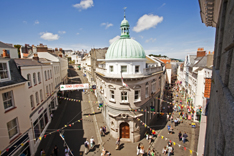
Sick of the USA? Let’s Move to Guernsey!

Ah, the digital age.  From the middle of nowhere, with a few strokes of my keyboard, I can reach and influence people from . . .  well, another middle of nowhere.

Today I glanced at the hit statistics for my blog site.  As always, most of my hits are from the United States.  A few from Canada, Australia, and the UK.  And the usual smattering of others from assorted spots around the globe.

Today, I got a hit from the nation of Guernsey!

What, you never heard of Guernsey?  Well I have.  There was a little news item about Guernsey a month or so back, and somehow I saw it, and it registered about 18k of information in a deep, dark crevice of my ever-shrinking grey matter.

I remembered reading that there is this little island off the coast of England, where the main industry is selling business and shipping licenses to people who don’t want to be under the thumb of any other recognized government.  They have a radio station, some cows, a few pubs of course, and I remembered they have a really neat sovereign gold coin.  They act like Brits, but are really an independent nation.

That’s about all the info you can fit in 18k.

So when I saw that I actually got a hit from Guernsey, I did a web search and discovered their really cool little website.    I found that their government is mainly by committees of the states, and they choose a Chief Executive of the States.

Now I think I have about 21k of knowledge in there.

Anyway, if – after the election – you have had it with the United States, and can’t think of any place you want to move to, give some thought to Guernsey.

Or, alternatively, if we Montanans decide to secede from the United States, maybe we could go to Guernsey and take notes.

Anybody know how to milk a cow?

Tom Balek – Rockin’ On the Right Side

We gotta get out of this place
If it’s the last thing we ever do
We gotta get out of this place
Girl, there’s a better life for me and you

We Gotta Get Out Of This Place – the Animals