
Liberals, Please Don’t Ruin Sports For Our Kids

Conrads first baseball game 7My grandson just turned five, and that entitles me to coach his little league baseball team.  It’s Grandpa Heaven.  Our first game was last Saturday.

At this age, the coach pitches to his own players and if they can’t hit it after five good pitches, they hit from a tee.  My grandson smashed my first pitch into deep center field, but I digress . . .

I didn’t expect a baseball game for five-year-olds to have a political slant.  But it sure did.

Our team took the field first, and the other team sent up their first batter.  He hit a grounder to our first baseman, who stepped on the bag for the first out.  But instead of returning to the dugout, the batter stood on first base, held there by his coach.  My other coaches and I looked at each other, confused.  Our players looked at us wondering what was going on.  We told the opposing coach, “Hey!  That kid is out!”  (There are no umpires for T-ball.)

“No, we are going to let all the kids run the bases,” he said.  “Nobody goes out.”

The second batter hit a grounder to our pitcher, who tossed the ball to first base.  Out number two.  But no, the coach left both runners on the bases.  We didn’t put up a fight at the time, because it was our first year coaching in this league, and the other team’s coaches seemed to be veterans with authority.  “This is the way we play in this league,” they barked.  We had been given the leagues “rules” before the season started, stating, “There will be a maximum of 5 runs or 3 outs per inning, whichever comes first,” and “An out is an out.  Player must leave the field of play.”  Apparently rules mean as much to these dads as the Constitution does to President Obama.

This morning I wrote a note to the coach of our opposing team next week, asking him to agree that “an out is an out” in our upcoming game.  I explained that the kids were confused because rules weren’t enforced, and many of them were getting really bored because every play had the same outcome.  I copied my email to the league’s director.

That started a flurry of emails.  Turns out the league director is a knuckle-headed liberal who thinks that it is more “fun” for the kids to never fail than it is for them to actually succeed.  I pointed out that kids, especially at that age, need order and structure. They want to know what they are supposed to do.  What’s the point of throwing the ball to first base if the runner is always safe? And why bother to run hard to beat the throw if you will be safe anyway?  The “putout” is fundamental to baseball.  There is no game without it.  And besides, what is more fun than getting a legitimate base hit, or a putout?

The director, of course, launched into the predictable liberal tirade about the evils of competition.  “Besides, kids at this age never put anybody out anyway,” he claimed.  That got my daughter (assistant coach) into the fray.  “Our team made five putouts in the first inning, three in the second, and two in the third!” she countered.  She was a very competitive athlete in younger years, and was obviously keeping score, mentally.  “The other team got several putouts too.  So did the teams that played after us.”   She, too, pointed out that the players were getting bored because every play had the same outcome.

The director said he would think about it.  But I’m not optimistic that the integrity of our T-ball league will be saved from a liberal fate.

Why do liberals think they have the only correct understanding of fairness?  How fair is it when you put a kid out at first base and he gets to stay there anyway? A “game”, by definition, is a competition with a winner and a loser. Results. Consequences. Reality.  No consequences, no game.

Imagine the NCAA championship game coming up in a couple of weeks.  Every player gets to take the same number of shots.  Every shot is good for two points, whether it goes in the basket or not.  But nobody keeps score anyway, because it might make somebody feel bad. Do you think anybody would pay to watch?  Or want to play?  Even a five-year-old knows that’s just plain stupid.

** UPDATE 3/28/15 – our little “protest” worked – with support from other parents and coaches, we got the league director to enforce the rule.  Starting today, in our little kids baseball league, “an out is an out.”  Victory!

Tom Balek – Rockin’ On the Right Side

Rockin' On the Right SideJust to hit the ball, and touch ’em all
A moment in the sun
It’s a-gone and you can tell that one good-bye!

Center Field – John Fogerty


check out Fogerty’s “baseball bat” guitar!

Montana Employees ‘Most Engaged’ In the Nation

Gallup US Map Employee EngagementA Gallup poll was released this week with the headline:  Montana Ranks Highest in Employee Engagement in 2013 and 2014.

That Montana appears in a national news headline is, in itself, newsworthy.  The nation’s fourth-largest state geographically ranks only 44th in population, having just broken the 1 million mark.   With only seven people per square mile, this beautiful “fly over country” is generally pretty inconsequential to the national news media.

So when my beloved Big Sky State is granted a few inches of bold type, it gets my attention.  And as a retired business owner and manager – and an unabashed free-market capitalist – any discussion related to getting, keeping, and motivating employees is compelling to me.

Gallup’s poll asks employers to what extent their people are engaged and enthused about their work and workplace.  Are they passionate about their jobs?  Do they feel a “profound connection” to their company?

In Montana, apparently they do.  In New York, not so much.  What accounts for the difference?

The Gallup article concludes that employees in smaller businesses are more engaged than those lost in a sea of cubicles or a huge factory full of machines.  There are very few large businesses in Montana, so most employees work directly with the owners and managers of their companies.  They see and feel the connection between their own performance and the success of the business.  They rely more closely on each other and know that the success of the individual employee and the company are interwoven.

Another factor is geographic isolation.   Cattle outnumber people almost three to one in the Big Sky State.  My hometown, Lewistown, is the 16th largest city in Montana, with a population of almost 6,000.  Most Montanans live in or near very small communities, and the distance to most services that the rest of the country takes for granted is considerable.  It creates an uncommon level of self-sufficiency.  Montanans learn to weld so they can repair their own equipment.  They plow their own snow or else they would be stranded.  They voluntarily man the fire trucks and ambulances.   Waiting for government services is often just not an option.

And that just might be the difference between Montana and New York.

A few months ago when two feet of snow was predicted in New York, the government told residents to stay home.  And they did.  Two feet of snow in Montana just makes for better elk hunting.  Try telling Montana hunters to stay home after a fresh snow!  And a little snow certainly doesn’t keep those engaged Montana employees from going to work.

History teaches that dependence on government throttles personal ambition and motivation.   And excessive regulation and government control restricts economic growth and standards of living.  Montanans are currently waging what they consider to be an existential battle against federal encroachment, defending their water rights, their natural resources, and their land from a variety of federal programs that threaten seizure, severe regulation, or endless environmental litigation.   30% of Montana land is already “owned” by the federal government.

Montanans are engaged in preserving the sovereignty of their state and the ownership rights of their own property.  They are engaged in the safety, well-being and economic success of their families and communities.   Rather than wait for the federal government to determine their needs and provide for them, Montanans would just as soon the feds butt out.

It’s not hard to see why Montanans are more engaged in their employment than most other Americans.

see this article in its entirety at Watchdog Arena

Tom Balek – Rockin’ On the Right Side

Rockin' On the Right Side

Together we’ll stand, divided we’ll fall
Come on now, people let’s get on the ball
And work together.
Come on, come on let’s work together
Because together we will stand
Every boy, every girl and man

The Newseum Tilts to the Left

newseumI was in Washington, DC yesterday and after I finished my business there I had a few hours of free time before my flight home.  I had been wanting to visit the Newseum, and here was my chance.

At this point I should come clean.  I must admit that I have an addiction.  My name is Tom Balek, and I am a newsaholic.

There, I said it.  Ever since high school journalism class I have had a fascination with news – the process of investigation and reporting, the incredible importance and power of freedom of the press, the technology, the ethics, the relentless pace, the pathos of a great story well written.   I spent many hours working on my high school paper, and after college I taught journalism for a couple of years in small-town Montana.

Back then journalism students learned that impartial honesty and accuracy were sacrosanct to a reporter or editor.  A journalist was duty-bound to report the facts and nothing else.  Facts must be verified and double-verified.  Opinion was not allowed outside the confines of the editorial section.  That was that.

It was the “Edward R. Murrow” school of journalism.   Murrow has been credited with creating radio and television news as we know it.  Or, I should say, knew it.  Modern news reporting came of age during World War II, and pioneers like Murrow set the bar high.

Then, as we all know, journalism changed.  Some years ago I had an animated discussion with a top news producer for ABC about what I felt was a growing liberal bias in news reporting.  He very candidly told me that as far as he knew, at least in his own news division, there was (at that time) no left vs. right bias. The mission of his department was to produce news stories that would increase ratings and thereby maximize ad revenue.  Period.

That caused me to ponder whether the news is a reflection of real life, or real life is a product of the news.  I concluded that the question is really not that deep:  the news media merely pander to the latest whims of pop culture in search of ratings.

This was just before the first Obama election, and we all know what happened to the news media since then.  Chris Mathews’ “thrill up my leg.”  The defense of blatant lies by the State Department about the Benghazi embassy attack. The blind eye to the attorney general’s Fast and Furious scandal.  The refusal to report the IRS targeting of opponents of the administration.  While talk radio and Fox News built a thriving industry on the popularity of conservative opinion and news analysis, the liberal media bias in hard news reporting became almost universal.  Ratings were no longer the primary objective.  Networks like MSNBC and CNN persisted in their liberal propaganda campaigns despite plummeting viewership.

Nowhere is this liberal bias more evident than at the shrine of the news industry, the Newseum.  It would be naive to expect anything else.  Study after study has determined that modern journalists are predominantly liberals and any pretense of adherence to the Edward R. Murrow rules of journalistic propriety is routinely sacrificed to the mission, as defined by Peter Jennings: “Those of us who went into journalism in the ’50s or ’60s, it was sort of a liberal thing to do: Save the world.”

While the Newseum does point out some ‘errors in fact’ produced by the news media over the years (Dewey Defeats Truman), it has no criticism of MSNBC’s Al Sharpton, who remains immune from a history of outrageous lies, including his totally fabricated story of the rape of Tawana Brawley by a group of Boston police officers and an attorney. Only fleeting mention is made of the pioneers of conservative media, such as Rush Limbaugh, Glenn Beck, and Andrew Breitbart, who had a profound effect on national politics and culture.  And that fleeting mention is pointedly disparaging.

At least half the displays in the Newseum were dedicated to the civil rights movement, featuring compelling stories, photos, and video of Ku Klux Klan rallies and violent abuse of southern blacks.  But there was not a single mention of the ties between the Democrat party and the Klan, or the Republican leadership against segregation.

Thomas Jefferson said, “Were it left to me to decide whether we should have a government without newspapers or newspapers without a government, I should not hesitate a moment to prefer the latter. But I should mean that every man should receive those papers and be capable of reading them.”  Unfortunately, the average citizen today is not very discerning – only 36% of adults know the three branches of government – and the news industry does not hesitate to take advantage of our ignorance.

The Newseum aspires to be a “champion of the first amendment” and promotes the value of freedom of the press.  It admits, in one display, that bias can exist in news reporting, and then points to Fox News as an example.  If only it could see this failing within its own left-tilting walls.

Tom Balek – Rockin’ On the Right Side

Rockin' On the Right Side


I make my living off the Evening News
Just give me somethin’, somethin’ I can use
People love it when you lose, they love dirty laundry

Dirty Laundry – the Eagles

Even idiot rock stars can’t resist taking a shot at Fox News:

Mulvaney: Budget Committee to Push Zero-Based Budgeting

zero

see this article in its entirety at Watchdog Arena

There is no mystery to budgeting.  Whether you manage the finances for your family, your little league baseball team, or your business, you and everybody else in the private sector makes spending decisions the same way:  you determine how much money is available, and you set priorities for how to spend (or save) it.

Why is our federal government incapable of writing and managing a budget?

Those of us who live in the real world use a process called zero-based budgeting.  You may have never heard of the term.  It is such a common-sense approach that we all do it instinctively.  We categorize our spending into “needs” and “wants”.  Needs get priority.  We provide our families the necessary things like shelter and food before we start thinking about vacations, big screen televisions, and concert tickets.  If there are remaining “discretionary” funds, we decide how to spend or save them.

Unfortunately, that’s not the way that government – especially the federal government – thinks.

The way government has operated for many years, every department is entitled to the amount they spent last year, plus an increase.  Call it “continuing resolution”, “continuing appropriation”, or whatever – I call it flat-out laziness.  One of the primary responsibilities of our congress is to make sure that the funds taken from citizens are necessarily and appropriately spent.  Oversight of government spending should be priority one.  Unfortunately, it gets little, if any, attention from our elected officials, who spend their days pondering such weighty issues as whether the one tenth of one percent of the population who are sexually confused should get to choose which public bathroom they use.

You see, it is hard work to dig into the details of how each department and agency spends its money.  It’s much easier to just give each whatever amount they got last year, plus a kicker – because the employees probably deserve a raise, right?

Wouldn’t it be a refreshing change if congress did its job and started managing our money the way the rest of us do?

Maybe there is hope.  I asked my congressman, Mick Mulvaney (R-SC), who sits on the House Budget Committee, if there is any chance that the federal government might adopt zero-based budgeting.  I was surprised at his answer.  “I fully expect the House to pass budget reform this year, and that will include zero-based budgeting,” Mulvaney said.

This could be big.  Existing programs are never cut back, only increased.  And new programs require new funding.  Is it any wonder our national debt spirals out of sight?  Imagine our government agencies having to justify every program, every expenditure, every employee, every line item, on a yearly basis.  Just like businesses do.  Just like your family does.

“There is a chance it will pass and get signed,” Mulvaney said.  “The budget process is really, really boring but really, really important.  And it hasn’t been reformed since 1974.  It will be the biggest story you won’t hear much about in DC this year.”

Some political analysts advocate the “penny plan” as a budget-balancing measure.  The penny plan would cut one cent across the board from every dollar the federal government spends for five years, and then put a cap on national spending at 18% of GDP.  Mathematically it works, but it doesn’t address the fact that some spending is totally wasted, while not enough is allocated to other important work that taxpayers would support.  Cutting back on totally worthless programs while starving worthwhile ones is not good oversight.

Many programs, like the corrupt, obsolete Export-Import Bank, continue year after year with no justification other than inertia.  To this point, Congress hasn’t been able to muster the willpower to put these programs to bed even after they have long outlived their purposes, and they continue to stumble around like aimless zombies lost in timeless hell.  If every program had to justify its budget annually, we could quickly gain the upper hand over our exploding debt.

Here’s hoping the most important number in government this year is zero.

Tom Balek – Rockin’ On the Right Side

Rockin' On the Right SideMaybe I’ll win
Saved by zero.
Maybe I’ll win!
Saved by zero.

Saved By Zero – the Fixx


Net Neutrality Could Make MSNBC Official Govt. News Agency

Juli Hanson – Shutterstock.com

In today’s 30-second sound-bite world it’s so easy to pull one over on the American people.

“Net Neutrality? What’s in it for me? Oh, I will get the same high-speed broadband as the big guys for the same price? Cool. I’m for that. Hey, look at this Beyonce video!”

It’s the old tried-and-true class-envy play: Promise to take something away from the big, rich corporations and give it to the ‘little people,’ who won’t ask any questions about the details or the real motives.

This week the FCC will vote on Net Neutrality, a proposal which would authorize them to regulate the internet as a public utility. As recently as Monday FCC chairman Tom Wheeler again refused to release the details of the regulation to the general public until after the vote.   Like ObamaCare, we won’t know what’s in the bill until we pass it. And like ObamaCare, when we know, we won’t like it.

Some of the dangers of Net Neutrality are obvious: whenever the government takes over a segment of the economy, competition is throttled. Prices are higher, service levels are worse, and a few well-connected pay-for-play corporate cronies are the big winners. No wonder Comcast and a few other mammoth internet players are huge supporters of Net Neutrality.

Some of the dangers are not so obvious.  Here’s one: Is there any doubt that an administration which frequently tests the limits of the Constitution would use this new authority to intercept and accumulate web data for political purposes?   You might want to hold back on making those online contributions to your favorite conservative candidate.

Here’s another: Big-government Democrats have long wanted to stifle conservative voices by reinstating the “Fairness Doctrine”. Having control of the internet would give them the tools to accomplish just that.  Broadcast, cable, and satellite television will soon be obsolete as more consumers receive their news and entertainment digitally over the web. It’s not hard to imagine MSNBC, owned by Comcast, being ‘selected’ as the government’s official news outlet.

[please see the rest of my article by following this link to WatchdogArena.com]

Tom Balek – Rockin’ On the Right Side

Rockin' On the Right Side

School Choice and Fairness

school-bus-1368136904lVvQuestions of “fairness” come up often in the debate over school choice.

Is it fair that some students attend quality public schools and get a great education while others are left in failing and dangerous schools?  Is it fair that one school district receives and spends $30,000 per student while another can only muster $6,500?  Is it fair that some families can afford to send their children to private schools while others must attend the school assigned to them by the government?

These are all part of the bigger issue of redistribution of wealth:  Is it fair for the government to take, by force, the property of one citizen and give it to another?

Americans almost universally agree that a good education system is necessary for our collective security and economic well-being, and we are all happy to contribute our fair share to that end.  To a point.

A while back I was discussing school funding with a friend, state representative Ryan Osmundson, who owns a cattle feed business in rural Montana.  I told him I was astonished that many rural school districts had budgets of $22,000 per student and up.  I facetiously asked if a local rancher with four kids went to the school office every fall and wrote a check for $88,000.

Of course they don’t.  And I doubt that very many parents think about where the money came from before it went to their football team, their books, their desks and their teachers.  Reality check:  if you didn’t write a check (or pay property tax) for your school’s average cost per student times the number of students you are sending to school, somebody else is paying your bill.  Is that fair?

But back to Osmundson.  “That’s not the half of it,” he said.  “The superintendent of my rural school district is after me all the time because I am home-schooling my six kids.  He says I am costing his district a lot of money by keeping six students off the school rolls.”

I blinked a couple of times, trying to absorb how not sending kids to school costs money.

Then Osmundson said, “I told the superintendent he should be thanking me.  The way I see it, I am saving the taxpayers $132,000 a year, and paying schools taxes to boot!”

My daughter is home schooling her twins while paying for schools they don’t use.  Fair?

Earlier this month I learned much about school choice at the Franklin Center’s “Amplify Choice” conference in Washington, DC.  Spending per student at a private high school we visited was about half that of the public schools, and yet the quality of education was vastly superior.  Spending and results are clearly not directly correlated.

We agree that it is in our best interest to educate all of our children to the highest standard that is practical, and there is really only one fair way to share the cost of that effort:  education funds must travel with the student to the competing school of his family’s choice.

Whether in the form of school vouchers, or tax credits, or scholarships, or one of the many other “backpack” funding plans, only when the money follows the student will our education system be fair.

Tom Balek – Rockin’ On the Right Side

Rockin' On the Right Side
Treat me right!  Treat me right!
Open your eyes,
Maybe you’ll see the light.
Ooh-ooh, Treat me right!

Treat Me Right – Pat Benatar

China Has ‘Net Neutrality’: Govt. Control of Internet Is Coming To America, Too

China ComputerIn a few weeks Congress will vote on a “net neutrality” bill that would turn significant control of the internet over to the federal government by allowing the FCC to regulate Internet Service Providers (ISPs) as public utilities.The bill is promoted using the same “class envy” technique that has been so politically successful over the years: “Just let us handle everything, and we will make sure internet access is ‘fair’.”  The legislation would, for example, prevent ISPs from charging some customers more than others for higher speed services, and from controlling access to certain internet content.  Sounds altruistic, doesn’t it?
History has proven that every time government takes a market segment away from the public sector, the product ultimately costs more, performs worse, is harder to get, and ends up profiting a select few well-connected cronies at taxpayer expense.

If the FCC takes control of our internet service, there is risk – perhaps likelihood – that competing ISPs will be pared down to a select few “winning” vendors.  Is it any wonder that Comcast, owner of the blatantly pro- big government news channel MSNBC, and one of the largest contributors to the Obama campaign, is a full-throated supporter of the net neutrality bill?  In these kinds of quid pro quo arrangements, make no mistake – the deep-pockets federal government trades cash for control. And the cash is non-partisan. Bill sponsors Fred Upton (R-MI) and Greg Walden (R-OR) received hefty contributions from AT&T, Comcast, Time Warner, and Verizon.

For a sneak preview of net neutrality, let’s take a look at internet life in the People’s Republic of China.  Regional ISPs in China are owned and operated by the government, who rigidly controls content as well as access to the internet.  The Communist party thwarted early attempts by its rival China Democracy Party to establish unrestricted internet access, enforced by arrests and imprisonment.   The Chinese government’s internet authority is documented in their “Computer Information Network and Internet Security, Protection, and Management Regulations”, approved by the State Council in 1997:

[to see the rest of my post please follow this link to Watchdog Arena]


Tom Balek – Rockin’ On the Right Side

Rockin' On the Right Side

A Pat On the Butt for the Democrats

Jayhawk Perry Ellis dunks

photo by Rich Sugg – Kansas City Star

Point guard Frank Mason of the Kansas Jayhawks took the outlet pass and pounded the ball down the left sideline on the fast break.  Out of the corner of his eye he saw teammate Perry Ellis racing for the basket behind the TCU defender.  Mason lobbed a perfect pass over the rim to Ellis and BOOM!  With one hand Perry caught the ball and hammered it down through the rim, even while being fouled.  “That’s gonna be on Sports Center,” chuckled the TV announcer.  Wide-eyed fans howled as the cameras panned their faux-shock-and-awe faces.

One of the TCU players passed behind Perry at the free throw line and gave him a pat on the butt.  Even though they are mortal enemies, a great play like that has to be recognized.

This morning I have to give the Obama administration a little pat on the butt.

Don’t get me wrong, we are mortal enemies too.  I am furious and frightened by almost everything this administration does.  But I have to admire how well they execute their game plan.  Nothing is left to chance.  No player on the administration’s team makes a free-style move.  Every statement is carefully coordinated.  They all get the memo, and they all follow the script.

Following Obama’s claims last week that poverty is the root of terrorism, the administration sent out State Department’s Marie Harf to explain why young men become terrorists, behead Christians, and burn victims alive in cages.  Harf said, “We need the media to go after the root causes that lead people to join these groups, whether it’s a lack of opportunity for jobs … ”  And this: “They are using social media to get converts to their cause and to spread their hatred all over the world.”

Today Jeh Johnson, director of Homeland Security, was the administration’s point guard, running the offense from the same playbook.  He, too, blamed social media – repeatedly – for ISIS’s organizational success, along with poverty and joblessness.  And he threw in, for good measure, the need for Congress to fully fund Homeland Security while disregarding the president’s executive amnesty edicts.

Absurd.  Blaming social media for the ISIS atrocities is like blaming Hitler’s World War II barbarity on the telephone.  And, as George Will pointed out, singling out poverty as the cause of terrorism is “an insult to poor and jobless people all over the world who don’t strap bombs onto their women and children and send them into shopping centers to kill innocent strangers.”  Not to mention, most ISIS terrorists are far from destitute, according to CNN’s national security analyst Peter Bergen.

But here’s why I have to give the “pat on the butt”.

This week Congress will have a hearing and likely a vote on whether to turn control of the Internet over to the FCC by classifying it as a public utility.  The “Net Neutrality” issue has been misrepresented, misreported, and remains totally misunderstood by most Americans, and unfortunately by most of our legislators, who swallow the warm, fuzzy claims that we poor citizens must be protected from the money-hungry huge corporations who want to deny us fair access to the internet.  Government good!  Competitive free internet bad!  In reality, it is yet another federal power-grab that would result in poorer internet access and performance, loss of privacy to government snooping, and huge profits for a select few crony corporations at taxpayer expense.  (Is it any wonder Time Warner / ComCast is a huge supporter of net neutrality?)

Concurrently, the Obama administration is pushing for a new blowout budget with higher spending on social programs, and they want Congress to release its hold on funding Homeland Security and allow Obama’s executive amnesty edicts to continue unfettered.

The administration is using the “ISIS Crisis” to drive home their real domestic agenda:  Pass Net Neutrality and give the government control of the web.  Pass the budget and give the government more taxpayer money for the ‘poor and jobless’ (mainly more government jobs).  Fund HHS without restrictions so we can open the borders and give full rights and benefits to illegal immigrants.

More government control.  More dependence on big government.  More Democrat voters.

I hate it.   I hope to hell enough thoughtful people see through it.   But Democrats, I have to give you a patt on the butt for executing a great play.

Tom Balek, Rockin’ On the Right Side

Rockin' On the Right SideFrom Piston Pete to Doctor J,
Michael Jordan’s fadeaway,
Hip hop is the way I live
And basketball’s the game I play

March Madness is around the corner, and then the NBA playoffs!
Here is the very indiscreet, racist, misogynistic, nasty, politically incorrect and mostly funny original by Cheech and Chong – watch at your own risk, you will be offended, and I am not responsible for content!   1975 was a very different time!


K-12 Spending: more, More, MORE!

Education spending.  More is better, right?

For years we have heard reports that teachers are forced to buy paper and supplies out of their own pockets, that some teachers qualify for food stamps, and that there have been “draconian cuts” to K-12 education budgets for decades.  Stories of the heartless underfunding of education are delivered with emotion and indignation, but seldom with statistical validation.

As student scores, college readiness and employability of graduates continue to decline across the U.S., the mantra of educators and progressives increases in volume and pitch.  “More money.  Just give us more money.  All we need is MORE MONEY!”

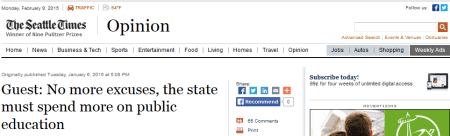
Seattle Times Headline Ed Spending

At a recent conference on school choice presented by the Franklin Center, Dr. Ben Scafidi shredded many of the myths about American taxpayers short-shrifting students.

Scafidi, director of the Economics of Education Policy Center at Georgia College and State University, said spending per student continues to increase sharply, studies prove that student achievement does not rise as a result of more spending, and there is no evidence that students are any harder to teach than they ever were due to non-school influences.

The most compelling finding of Scafidi’s 2012 study titled “The School Staffing Surge – Decades of Employment Growth in America’s Public Schools is this:

From 1950 to 2009 the number of students increased by 98%.  The number of teachers in public schools increased by 252%.  Meanwhile the number of administrators and other school staff increased by 702%.

Scafidi said, “If from 1992 to 2012 our public schools had increased non-teacher staff at the same rate that it increased teaching staff, it would have freed up $26.5 billion per year in education funds.  That could translate to an $8500 raise for every teacher, or a huge reduction in taxes, or scholarships that would allow many students to attend the schools of their choice.”

Opponents of school choice contend that students who remain in traditional public schools are harmed when budget dollars follow students to private or charter schools.  But Scafidi points out that charter and private schools operate so much more efficiently than the traditional public schools that fixed costs for the existing schools (about 36%) can still be covered by available funds and the remaining students in those schools benefit by the reduced variable costs.

Clearly there is no direct equivalency between dollars spent per student and results.  Test scores, graduation rates, and college matriculation at the private and charter schools I visited in Washington, DC were nothing short of miraculous compared to those of the traditional DC public schools, despite spending less than half the amount per student.

In previous posts I have reported school budgets in rural Montana schools of $22,000 per student per year.  While many of these students are getting a great education, by no means are they twice as smart as their city-school peers.  The cost is merely a function of declining numbers of students versus increasing costs, largely spending required by federal and state regulations and not the local school board.

I have personally seen many aggregious examples of non-academic school spending.  One Montana school district with 350 high school students keeps a stable of five cruiser buses, most equipped with personal video players, for their athletic and extracurricular teams.  Schools so small they can only play six-man football travel 350 miles to games.  My local school district in South Carolina just spent $6 million on artificial turf.  That’s got to affect the cost per student, without really improving student outcomes, wouldn’t you say?

Voters and taxpayers: next time you hear educators and progressives hollering for “more, more, more money!” you might ask how the extra dollars will be spent and how will students benefit.  Better yet, demand that the dollars coming from your hard earned pay can go with each student to the school of his or her choice.

Tom Balek – Rockin’ On the Right Side

Rockin' On the Right Side

And when you ask ’em, “How much should we give?”
Ooh, they only answer “More! More! More!”, y’all
It ain’t me, it ain’t me, I ain’t no millionaire’s son
It ain’t me, it ain’t me, I ain’t no fortunate one!

What Do Jews and Muslims Have in Common?

photo courtesy Tea Party News Network

photo courtesy Tea Party News Network

These are trying times.

I know every generation thinks their time in history is the most challenging, the most significant, the most “historic”.  I will not claim that today’s challenges rise to the level of World War II, or the fall of the Roman Empire, or the bubonic plague of the Middle Ages.

Still, these are trying times.  And the issue of our day is the rapid advance of extremist Muslims across the globe.

What baffles non-Muslims is how moderate (non-violent) Muslims seem to tolerate the horrendous violence of their radical brethren.

Our own president, who attended a Muslim elementary school, gives moderate Muslims a pass.  In a CNN interview with Fareed Zakaria, President Obama said, “I don’t quibble with labels. I think we all recognize that this is a particular problem that has roots in Muslim communities.  But I think we do ourselves a disservice in this fight if we are not taking into account the fact that the overwhelming majority of Muslims reject this ideology.”

If an “overwhelming majority of Muslims” reject terrorism, why don’t they do something about it?  Have you heard anything about moderate Muslims speaking up against the beheadings, murders, and abuse of children and women?

They don’t.  I’m pretty sure that’s because they are AFRAID.  Extremist Muslims murder moderate Muslims all over the world with glee and abandon.  Would you be willing to make yourself a target of these maniacs?

European Jews were abused and murdered by the millions during World War II.  Weighing heavy on the minds of Gentiles who weren’t there is the question:  Why didn’t they put up a fight?

Of course, many Jews did.  But many more left their homes, boarded the trains, and followed the orders of the Nazi murderers because . . . they were AFRAID.

Who wouldn’t be?  It’s so easy for those of us who are not a target to diminish those who are, but who don’t put up a fight.  And it’s so easy to disengage from the conflict and mind our own business.

If history teaches us anything, it is this:  we must fight evil, wherever it surfaces.  Not some of us, all of us.  Tyranny, violence, and oppression is wrong, in any language and in any true religion.  And while it’s hard for an individual to fight the power, it is much easier and more effective if we bring our numbers to the battle.

The Jews in World War II and all those who face extremist Islam today – Christians, Jews, moderate Muslims, and any unlucky soul who strays into the path of the evil Muslim mayhem – share the need to stay alive.  Pity those who shrink from the task at hand.

Tom Balek – Rockin’ On the Right Side

Rockin' On the Right Side
Keep yourself alive, keep yourself alive.
It’ll take you all your time and money, honey you’ll survive
Keep yourself alive

Queen – Keep Yourself Alive