
Back in the 1980s I was CFO for a family-owned chain of lumber yards and home centers. The company had grown to about 300 employees, and was making the transition from a small, easy-going operation to a more fast-paced, modern corporation.
Like most companies of that age and size, mine provided its employees a defined-benefit pension plan. A defined-benefit plan is one in which employees are guaranteed a specific monthly check at retirement.
There were several problems inherent in these defined benefit plans. The amount received by the employee after decades of service was actually pretty minimal. The insurance companies who ran the plans quietly took a huge slice of the pie for their participation, and paid minimal interest on the funds they held. If an employee changed jobs before he was fully “vested”, he lost most, if not all, of his pension. And many of these plans were “overfunded”, meaning the company had paid more money into the plan than the employees would ever be able to receive – this cash should be used by the company for some purpose other than making the insurance company richer.
We made the decision to terminate our defined pension plan and convert to a new 401(k) defined contribution plan, which had just been authorized by Congress. Employees were encouraged to save some money, tax deferred, from every check, and the company generously matched the employee’s contribution. Employees chose how they wanted to invest their savings, and in no time we all had considerable accounts to look forward to in retirement, which we could take with us if we changed jobs.
The difference between “defined benefit”, which promises security but not prosperity, and “defined contribution”, which offers rewards based on saving and investing, is the difference between “communism” and “capitalism”.
And it is what killed Detroit. It will kill more cities and states, and perhaps our nation, if we don’t learn this difference and take action now.
Our government union employees are about the only workers left in our country who are promised a guaranteed, and in most cases very lucrative, income at retirement. Virtually no businesses operate this way. Our government officials have promised their union employees a great deal more money than they can extract from the taxpayers. The result is economic disaster.
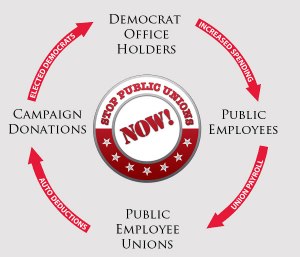 How did this happen? Simple. Elected officials control the compensation paid to their union employees as well as the revenues extracted from taxpayers. Union employees promise to help (with cash and labor) elect the politician. When elected, the politician pays the union back with higher compensation, using money that is extracted from the taxpayers. It goes around and around until the government is broke.
We must guard against government growth with every breath. The framers of our constitution were trying to create a system that would not be subject to the corruption that has eventually destroyed every government in history. Government must be restricted to only strictly necessary spending, according to the constitution, and let the miracle of free-market economics build our wealth and improve the standard of living for all.
The only way out is to elect officials who will eliminate government employee unions, and stop the unholy cycle of pay-backs. Government employees should be compensated fairly based on actual performance, and compete for their jobs, just as employees in the private sector do.
Before you vote for any elected official, ask him or her for a statement of position on government employee unions.
Tom Balek – Rockin’ On the Right Side

Too many people need me
I’ve got so much, so much to do
But when my traveling is over
I’ll pay you back with interest
I’ll pay you back with interest

 Tom Balek - Rockin' On The Right Side