
Mulvaney: Budget Committee to Push Zero-Based Budgeting

zero

see this article in its entirety at Watchdog Arena

There is no mystery to budgeting.  Whether you manage the finances for your family, your little league baseball team, or your business, you and everybody else in the private sector makes spending decisions the same way:  you determine how much money is available, and you set priorities for how to spend (or save) it.

Why is our federal government incapable of writing and managing a budget?

Those of us who live in the real world use a process called zero-based budgeting.  You may have never heard of the term.  It is such a common-sense approach that we all do it instinctively.  We categorize our spending into “needs” and “wants”.  Needs get priority.  We provide our families the necessary things like shelter and food before we start thinking about vacations, big screen televisions, and concert tickets.  If there are remaining “discretionary” funds, we decide how to spend or save them.

Unfortunately, that’s not the way that government – especially the federal government – thinks.

The way government has operated for many years, every department is entitled to the amount they spent last year, plus an increase.  Call it “continuing resolution”, “continuing appropriation”, or whatever – I call it flat-out laziness.  One of the primary responsibilities of our congress is to make sure that the funds taken from citizens are necessarily and appropriately spent.  Oversight of government spending should be priority one.  Unfortunately, it gets little, if any, attention from our elected officials, who spend their days pondering such weighty issues as whether the one tenth of one percent of the population who are sexually confused should get to choose which public bathroom they use.

You see, it is hard work to dig into the details of how each department and agency spends its money.  It’s much easier to just give each whatever amount they got last year, plus a kicker – because the employees probably deserve a raise, right?

Wouldn’t it be a refreshing change if congress did its job and started managing our money the way the rest of us do?

Maybe there is hope.  I asked my congressman, Mick Mulvaney (R-SC), who sits on the House Budget Committee, if there is any chance that the federal government might adopt zero-based budgeting.  I was surprised at his answer.  “I fully expect the House to pass budget reform this year, and that will include zero-based budgeting,” Mulvaney said.

This could be big.  Existing programs are never cut back, only increased.  And new programs require new funding.  Is it any wonder our national debt spirals out of sight?  Imagine our government agencies having to justify every program, every expenditure, every employee, every line item, on a yearly basis.  Just like businesses do.  Just like your family does.

“There is a chance it will pass and get signed,” Mulvaney said.  “The budget process is really, really boring but really, really important.  And it hasn’t been reformed since 1974.  It will be the biggest story you won’t hear much about in DC this year.”

Some political analysts advocate the “penny plan” as a budget-balancing measure.  The penny plan would cut one cent across the board from every dollar the federal government spends for five years, and then put a cap on national spending at 18% of GDP.  Mathematically it works, but it doesn’t address the fact that some spending is totally wasted, while not enough is allocated to other important work that taxpayers would support.  Cutting back on totally worthless programs while starving worthwhile ones is not good oversight.

Many programs, like the corrupt, obsolete Export-Import Bank, continue year after year with no justification other than inertia.  To this point, Congress hasn’t been able to muster the willpower to put these programs to bed even after they have long outlived their purposes, and they continue to stumble around like aimless zombies lost in timeless hell.  If every program had to justify its budget annually, we could quickly gain the upper hand over our exploding debt.

Here’s hoping the most important number in government this year is zero.

Tom Balek – Rockin’ On the Right Side

Rockin' On the Right SideMaybe I’ll win
Saved by zero.
Maybe I’ll win!
Saved by zero.

Saved By Zero – the Fixx


Net Neutrality Could Make MSNBC Official Govt. News Agency

Juli Hanson – Shutterstock.com

In today’s 30-second sound-bite world it’s so easy to pull one over on the American people.

“Net Neutrality? What’s in it for me? Oh, I will get the same high-speed broadband as the big guys for the same price? Cool. I’m for that. Hey, look at this Beyonce video!”

It’s the old tried-and-true class-envy play: Promise to take something away from the big, rich corporations and give it to the ‘little people,’ who won’t ask any questions about the details or the real motives.

This week the FCC will vote on Net Neutrality, a proposal which would authorize them to regulate the internet as a public utility. As recently as Monday FCC chairman Tom Wheeler again refused to release the details of the regulation to the general public until after the vote.   Like ObamaCare, we won’t know what’s in the bill until we pass it. And like ObamaCare, when we know, we won’t like it.

Some of the dangers of Net Neutrality are obvious: whenever the government takes over a segment of the economy, competition is throttled. Prices are higher, service levels are worse, and a few well-connected pay-for-play corporate cronies are the big winners. No wonder Comcast and a few other mammoth internet players are huge supporters of Net Neutrality.

Some of the dangers are not so obvious.  Here’s one: Is there any doubt that an administration which frequently tests the limits of the Constitution would use this new authority to intercept and accumulate web data for political purposes?   You might want to hold back on making those online contributions to your favorite conservative candidate.

Here’s another: Big-government Democrats have long wanted to stifle conservative voices by reinstating the “Fairness Doctrine”. Having control of the internet would give them the tools to accomplish just that.  Broadcast, cable, and satellite television will soon be obsolete as more consumers receive their news and entertainment digitally over the web. It’s not hard to imagine MSNBC, owned by Comcast, being ‘selected’ as the government’s official news outlet.

[please see the rest of my article by following this link to WatchdogArena.com]

Tom Balek – Rockin’ On the Right Side

Rockin' On the Right Side

School Choice and Fairness

school-bus-1368136904lVvQuestions of “fairness” come up often in the debate over school choice.

Is it fair that some students attend quality public schools and get a great education while others are left in failing and dangerous schools?  Is it fair that one school district receives and spends $30,000 per student while another can only muster $6,500?  Is it fair that some families can afford to send their children to private schools while others must attend the school assigned to them by the government?

These are all part of the bigger issue of redistribution of wealth:  Is it fair for the government to take, by force, the property of one citizen and give it to another?

Americans almost universally agree that a good education system is necessary for our collective security and economic well-being, and we are all happy to contribute our fair share to that end.  To a point.

A while back I was discussing school funding with a friend, state representative Ryan Osmundson, who owns a cattle feed business in rural Montana.  I told him I was astonished that many rural school districts had budgets of $22,000 per student and up.  I facetiously asked if a local rancher with four kids went to the school office every fall and wrote a check for $88,000.

Of course they don’t.  And I doubt that very many parents think about where the money came from before it went to their football team, their books, their desks and their teachers.  Reality check:  if you didn’t write a check (or pay property tax) for your school’s average cost per student times the number of students you are sending to school, somebody else is paying your bill.  Is that fair?

But back to Osmundson.  “That’s not the half of it,” he said.  “The superintendent of my rural school district is after me all the time because I am home-schooling my six kids.  He says I am costing his district a lot of money by keeping six students off the school rolls.”

I blinked a couple of times, trying to absorb how not sending kids to school costs money.

Then Osmundson said, “I told the superintendent he should be thanking me.  The way I see it, I am saving the taxpayers $132,000 a year, and paying schools taxes to boot!”

My daughter is home schooling her twins while paying for schools they don’t use.  Fair?

Earlier this month I learned much about school choice at the Franklin Center’s “Amplify Choice” conference in Washington, DC.  Spending per student at a private high school we visited was about half that of the public schools, and yet the quality of education was vastly superior.  Spending and results are clearly not directly correlated.

We agree that it is in our best interest to educate all of our children to the highest standard that is practical, and there is really only one fair way to share the cost of that effort:  education funds must travel with the student to the competing school of his family’s choice.

Whether in the form of school vouchers, or tax credits, or scholarships, or one of the many other “backpack” funding plans, only when the money follows the student will our education system be fair.

Tom Balek – Rockin’ On the Right Side

Rockin' On the Right Side
Treat me right!  Treat me right!
Open your eyes,
Maybe you’ll see the light.
Ooh-ooh, Treat me right!

Treat Me Right – Pat Benatar

China Has ‘Net Neutrality’: Govt. Control of Internet Is Coming To America, Too

China ComputerIn a few weeks Congress will vote on a “net neutrality” bill that would turn significant control of the internet over to the federal government by allowing the FCC to regulate Internet Service Providers (ISPs) as public utilities.The bill is promoted using the same “class envy” technique that has been so politically successful over the years: “Just let us handle everything, and we will make sure internet access is ‘fair’.”  The legislation would, for example, prevent ISPs from charging some customers more than others for higher speed services, and from controlling access to certain internet content.  Sounds altruistic, doesn’t it?
History has proven that every time government takes a market segment away from the public sector, the product ultimately costs more, performs worse, is harder to get, and ends up profiting a select few well-connected cronies at taxpayer expense.

If the FCC takes control of our internet service, there is risk – perhaps likelihood – that competing ISPs will be pared down to a select few “winning” vendors.  Is it any wonder that Comcast, owner of the blatantly pro- big government news channel MSNBC, and one of the largest contributors to the Obama campaign, is a full-throated supporter of the net neutrality bill?  In these kinds of quid pro quo arrangements, make no mistake – the deep-pockets federal government trades cash for control. And the cash is non-partisan. Bill sponsors Fred Upton (R-MI) and Greg Walden (R-OR) received hefty contributions from AT&T, Comcast, Time Warner, and Verizon.

For a sneak preview of net neutrality, let’s take a look at internet life in the People’s Republic of China.  Regional ISPs in China are owned and operated by the government, who rigidly controls content as well as access to the internet.  The Communist party thwarted early attempts by its rival China Democracy Party to establish unrestricted internet access, enforced by arrests and imprisonment.   The Chinese government’s internet authority is documented in their “Computer Information Network and Internet Security, Protection, and Management Regulations”, approved by the State Council in 1997:

[to see the rest of my post please follow this link to Watchdog Arena]


Tom Balek – Rockin’ On the Right Side

Rockin' On the Right Side

A Pat On the Butt for the Democrats

Jayhawk Perry Ellis dunks

photo by Rich Sugg – Kansas City Star

Point guard Frank Mason of the Kansas Jayhawks took the outlet pass and pounded the ball down the left sideline on the fast break.  Out of the corner of his eye he saw teammate Perry Ellis racing for the basket behind the TCU defender.  Mason lobbed a perfect pass over the rim to Ellis and BOOM!  With one hand Perry caught the ball and hammered it down through the rim, even while being fouled.  “That’s gonna be on Sports Center,” chuckled the TV announcer.  Wide-eyed fans howled as the cameras panned their faux-shock-and-awe faces.

One of the TCU players passed behind Perry at the free throw line and gave him a pat on the butt.  Even though they are mortal enemies, a great play like that has to be recognized.

This morning I have to give the Obama administration a little pat on the butt.

Don’t get me wrong, we are mortal enemies too.  I am furious and frightened by almost everything this administration does.  But I have to admire how well they execute their game plan.  Nothing is left to chance.  No player on the administration’s team makes a free-style move.  Every statement is carefully coordinated.  They all get the memo, and they all follow the script.

Following Obama’s claims last week that poverty is the root of terrorism, the administration sent out State Department’s Marie Harf to explain why young men become terrorists, behead Christians, and burn victims alive in cages.  Harf said, “We need the media to go after the root causes that lead people to join these groups, whether it’s a lack of opportunity for jobs … ”  And this: “They are using social media to get converts to their cause and to spread their hatred all over the world.”

Today Jeh Johnson, director of Homeland Security, was the administration’s point guard, running the offense from the same playbook.  He, too, blamed social media – repeatedly – for ISIS’s organizational success, along with poverty and joblessness.  And he threw in, for good measure, the need for Congress to fully fund Homeland Security while disregarding the president’s executive amnesty edicts.

Absurd.  Blaming social media for the ISIS atrocities is like blaming Hitler’s World War II barbarity on the telephone.  And, as George Will pointed out, singling out poverty as the cause of terrorism is “an insult to poor and jobless people all over the world who don’t strap bombs onto their women and children and send them into shopping centers to kill innocent strangers.”  Not to mention, most ISIS terrorists are far from destitute, according to CNN’s national security analyst Peter Bergen.

But here’s why I have to give the “pat on the butt”.

This week Congress will have a hearing and likely a vote on whether to turn control of the Internet over to the FCC by classifying it as a public utility.  The “Net Neutrality” issue has been misrepresented, misreported, and remains totally misunderstood by most Americans, and unfortunately by most of our legislators, who swallow the warm, fuzzy claims that we poor citizens must be protected from the money-hungry huge corporations who want to deny us fair access to the internet.  Government good!  Competitive free internet bad!  In reality, it is yet another federal power-grab that would result in poorer internet access and performance, loss of privacy to government snooping, and huge profits for a select few crony corporations at taxpayer expense.  (Is it any wonder Time Warner / ComCast is a huge supporter of net neutrality?)

Concurrently, the Obama administration is pushing for a new blowout budget with higher spending on social programs, and they want Congress to release its hold on funding Homeland Security and allow Obama’s executive amnesty edicts to continue unfettered.

The administration is using the “ISIS Crisis” to drive home their real domestic agenda:  Pass Net Neutrality and give the government control of the web.  Pass the budget and give the government more taxpayer money for the ‘poor and jobless’ (mainly more government jobs).  Fund HHS without restrictions so we can open the borders and give full rights and benefits to illegal immigrants.

More government control.  More dependence on big government.  More Democrat voters.

I hate it.   I hope to hell enough thoughtful people see through it.   But Democrats, I have to give you a patt on the butt for executing a great play.

Tom Balek, Rockin’ On the Right Side

Rockin' On the Right SideFrom Piston Pete to Doctor J,
Michael Jordan’s fadeaway,
Hip hop is the way I live
And basketball’s the game I play

March Madness is around the corner, and then the NBA playoffs!
Here is the very indiscreet, racist, misogynistic, nasty, politically incorrect and mostly funny original by Cheech and Chong – watch at your own risk, you will be offended, and I am not responsible for content!   1975 was a very different time!


K-12 Spending: more, More, MORE!

Education spending.  More is better, right?

For years we have heard reports that teachers are forced to buy paper and supplies out of their own pockets, that some teachers qualify for food stamps, and that there have been “draconian cuts” to K-12 education budgets for decades.  Stories of the heartless underfunding of education are delivered with emotion and indignation, but seldom with statistical validation.

As student scores, college readiness and employability of graduates continue to decline across the U.S., the mantra of educators and progressives increases in volume and pitch.  “More money.  Just give us more money.  All we need is MORE MONEY!”

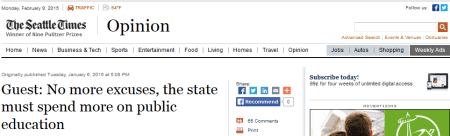
Seattle Times Headline Ed Spending

At a recent conference on school choice presented by the Franklin Center, Dr. Ben Scafidi shredded many of the myths about American taxpayers short-shrifting students.

Scafidi, director of the Economics of Education Policy Center at Georgia College and State University, said spending per student continues to increase sharply, studies prove that student achievement does not rise as a result of more spending, and there is no evidence that students are any harder to teach than they ever were due to non-school influences.

The most compelling finding of Scafidi’s 2012 study titled “The School Staffing Surge – Decades of Employment Growth in America’s Public Schools is this:

From 1950 to 2009 the number of students increased by 98%.  The number of teachers in public schools increased by 252%.  Meanwhile the number of administrators and other school staff increased by 702%.

Scafidi said, “If from 1992 to 2012 our public schools had increased non-teacher staff at the same rate that it increased teaching staff, it would have freed up $26.5 billion per year in education funds.  That could translate to an $8500 raise for every teacher, or a huge reduction in taxes, or scholarships that would allow many students to attend the schools of their choice.”

Opponents of school choice contend that students who remain in traditional public schools are harmed when budget dollars follow students to private or charter schools.  But Scafidi points out that charter and private schools operate so much more efficiently than the traditional public schools that fixed costs for the existing schools (about 36%) can still be covered by available funds and the remaining students in those schools benefit by the reduced variable costs.

Clearly there is no direct equivalency between dollars spent per student and results.  Test scores, graduation rates, and college matriculation at the private and charter schools I visited in Washington, DC were nothing short of miraculous compared to those of the traditional DC public schools, despite spending less than half the amount per student.

In previous posts I have reported school budgets in rural Montana schools of $22,000 per student per year.  While many of these students are getting a great education, by no means are they twice as smart as their city-school peers.  The cost is merely a function of declining numbers of students versus increasing costs, largely spending required by federal and state regulations and not the local school board.

I have personally seen many aggregious examples of non-academic school spending.  One Montana school district with 350 high school students keeps a stable of five cruiser buses, most equipped with personal video players, for their athletic and extracurricular teams.  Schools so small they can only play six-man football travel 350 miles to games.  My local school district in South Carolina just spent $6 million on artificial turf.  That’s got to affect the cost per student, without really improving student outcomes, wouldn’t you say?

Voters and taxpayers: next time you hear educators and progressives hollering for “more, more, more money!” you might ask how the extra dollars will be spent and how will students benefit.  Better yet, demand that the dollars coming from your hard earned pay can go with each student to the school of his or her choice.

Tom Balek – Rockin’ On the Right Side

Rockin' On the Right Side

And when you ask ’em, “How much should we give?”
Ooh, they only answer “More! More! More!”, y’all
It ain’t me, it ain’t me, I ain’t no millionaire’s son
It ain’t me, it ain’t me, I ain’t no fortunate one!

What Do Jews and Muslims Have in Common?

photo courtesy Tea Party News Network

photo courtesy Tea Party News Network

These are trying times.

I know every generation thinks their time in history is the most challenging, the most significant, the most “historic”.  I will not claim that today’s challenges rise to the level of World War II, or the fall of the Roman Empire, or the bubonic plague of the Middle Ages.

Still, these are trying times.  And the issue of our day is the rapid advance of extremist Muslims across the globe.

What baffles non-Muslims is how moderate (non-violent) Muslims seem to tolerate the horrendous violence of their radical brethren.

Our own president, who attended a Muslim elementary school, gives moderate Muslims a pass.  In a CNN interview with Fareed Zakaria, President Obama said, “I don’t quibble with labels. I think we all recognize that this is a particular problem that has roots in Muslim communities.  But I think we do ourselves a disservice in this fight if we are not taking into account the fact that the overwhelming majority of Muslims reject this ideology.”

If an “overwhelming majority of Muslims” reject terrorism, why don’t they do something about it?  Have you heard anything about moderate Muslims speaking up against the beheadings, murders, and abuse of children and women?

They don’t.  I’m pretty sure that’s because they are AFRAID.  Extremist Muslims murder moderate Muslims all over the world with glee and abandon.  Would you be willing to make yourself a target of these maniacs?

European Jews were abused and murdered by the millions during World War II.  Weighing heavy on the minds of Gentiles who weren’t there is the question:  Why didn’t they put up a fight?

Of course, many Jews did.  But many more left their homes, boarded the trains, and followed the orders of the Nazi murderers because . . . they were AFRAID.

Who wouldn’t be?  It’s so easy for those of us who are not a target to diminish those who are, but who don’t put up a fight.  And it’s so easy to disengage from the conflict and mind our own business.

If history teaches us anything, it is this:  we must fight evil, wherever it surfaces.  Not some of us, all of us.  Tyranny, violence, and oppression is wrong, in any language and in any true religion.  And while it’s hard for an individual to fight the power, it is much easier and more effective if we bring our numbers to the battle.

The Jews in World War II and all those who face extremist Islam today – Christians, Jews, moderate Muslims, and any unlucky soul who strays into the path of the evil Muslim mayhem – share the need to stay alive.  Pity those who shrink from the task at hand.

Tom Balek – Rockin’ On the Right Side

Rockin' On the Right Side
Keep yourself alive, keep yourself alive.
It’ll take you all your time and money, honey you’ll survive
Keep yourself alive

Queen – Keep Yourself Alive


School Choice in DC – It’s Working

lion_gazelle posterMark Roberts, graying but still athletic in his crisp suit and tie, stood in the center of his circle of 15 students.  Every eye was on the articulate and energetic instructor as he probed their understanding of the character in their literature assignment, “Things Fall Apart” by Chinua Achebe.  The high school juniors bounced their thoughtful and mature-beyond-years analyses off the teacher and each other.  There was not a slacker in the room; each young scholar was as bright and engaged as the next.  And I thought, “I have never seen a high school class like this.”

Like most conservatives, I have always advocated school choice.  In my Adam Smith / free market / supply and demand worldview, whenever consumers have a choice the right products are delivered at the right cost, guided by the “invisible hand” of the marketplace.  Competition drives excellence in every aspect of life.  Why would education be any different?

Last week at Archbishop Carroll Catholic high school in Washington, DC I saw the proof of the theory firsthand.  Without question, these kids have very bright futures and a leg up on their public-school peers.  Maybe two legs, an arm, and a head.

Located in the middle of one of DC’s lowest-income neighborhoods, Archbishop Carroll has evolved over the years.  The aging but well-maintained facility was originally a boy’s school, one of the first segregated schools in DC.  Carroll later went co-ed, absorbed students from other Catholic schools, and in recent years has become a highly-sought educational alternative for families who want to extract their children from the grim, underperforming DC public schools.  While Catholic religious training is offered at Archbishop Carroll, it is not required, and only about 20% of the students take CCD.

Tuition at Archbishop Carroll is about $13,000 per year – far below the amount taxpayers spend annually to educate students at the failing non-charter DC public schools.  Many families pay the full tuition out-of-pocket.  In the interest of diversity, discounts are offered to white, Asian, and Latino students (the student body is almost entirely African-American), as well as registered Catholics.  Over half the students would not be able to afford to attend Archbishop Carroll without grants from the Opportunity Scholarship Program.

Archbishop Carroll competes with other private and charter schools for students by offering families a rigorous, no-nonsense academic program in a safe and uplifting environment.  With strong emphasis on accountability, discipline and character development, Carroll provides the education product and opportunity for future success that most parents want for their children.  But the competition doesn’t end there.

On a tour of the school organized by the Franklin Center as part of their “Amplify School Choice” conference, I asked student Wanofe Mideksa if she is a “superstar”, hand-picked to entertain us.  “Not really,” she explained.  “All the students here are high-achievers, because we have to compete to get into Carroll.”  Students are selected for admission by test scores, admission essays and interviews.  Once enrolled, they have to maintain their motivation levels.  Most students take public transportation, some traveling as long as an hour each way.  They wear jackets and ties, and dresses.  They are addressed as “Mr.” and “Miss”  and decorum is maintained at all times.  The school deliberately sets tuition just beyond the scholarship amount to ensure that every family has “skin in the game.”

And Archbishop Carroll competes for the best instructors.  “Our teachers don’t sit down during class,” said the school president, Mary Elizabeth Blaufuss.  “You won’t find them texting when they should be teaching.  They are here because they want to be part of a serious academic program.”

Education is no different from any other product or service.  When consumers have choices and suppliers have to offer the very best products to compete for their business, everybody wins.

Tom Balek – Rockin’ On the Right Side

Rockin' On the Right Side

Did you ever have to make up your mind?
You pick up on one and leave the other one behind
It’s not often easy and not often kind
Did you ever have to make up your mind?

Did You Ever Have to Make Up Your Mind?  – The Lovin’ Spoonful


South Carolina Grassroots Conservatives – Something Old, Something New

TedCruz_at_2015SCTPCThe South Carolina Tea Party Coalition gathered last weekend in Myrtle Beach, and there was never a dull moment.  All the leading right-wing organizations were there, including the Tea Party Patriots, Freedom Works, the Heritage Foundation, the Tea Party Leadership Fund, and Americans for Prosperity.  Contenders for the 2016 presidential race made stump speeches.  Senators and congressmen tossed red meat to the hungry throngs.

The event sold out, skewering the notion that the Tea Party is in decline.   Conservative celebrities lined up to participate.  I have been attending events like this for a long time, and let me tell you – these people are more fired up than ever.

Some things haven’t changed.  Barack Obama remains the target of the Tea Party’s ire, and the conservative faithful are more baffled than ever that so many Americans are still oblivious to the damage he continues to inflict on our nation.  And the Tea Party is still an army of mostly gray-haired, fair-skinned grandmas and grandpas.

Yet the Tea Party and the conservative movement continues to evolve.

Lately the grassroots conservatives are as angry at Republicans as they are at arch-rival liberal Democrats.  They stood and cheered as speaker after speaker exhorted them to “hold the Republicans in DC accountable.”  Congressmen Louie Gohmert, Jim Bridenstine and Jeff Duncan got standing O’s specifically to thank them for their anti-Boehner votes.  Still, Rep. Mick Mulvaney came out guns blazing in defense of his vote for the Speaker, and scored some points.

Minorities continue to gain in numbers and in comfort level in Tea Party circles.  While they have always been warmly welcomed by the Tea Party, African American and Hispanic conservatives no longer feel conspicuous and are taking a significant leadership role.

A fairly large contingent of young conservatives also attended.  One of the most compelling presentations came from Lauren Cooley of Turning Point USA.   Cooley, a striking and very hip young lady, is winning high school and college students over to the conservative side at a wholesale clip.  She single-handedly shut down the gender-studies department and its series of obscene programs at Furman University, and handed attendees to a Jesse Jackson event a list of unflattering direct quotes by him, standing her ground in a confrontation with the embarrassed sponsors.  Her charges carry the pithy message, “Big Government Sucks”, and in growing numbers they understand and articulate the abuses heaped on young Americans by their government in recent years.

But the biggest change in the conservative movement is more subtle, and significantly more important.  Grassroots conservatives have learned that they must work within the system to accomplish real reform.  The days of loud complaints but little action are history, as conservative activists now work to reorganize precincts, run for local offices, and learn policy issues in detail, making them formidable citizen leaders and constituents.  And the top conservative organizations all have focused goals with serious action plans in place to accomplish them.

Two larger-than-life issues in South Carolina took center stage at the convention.  A determined group of conservatives led by Greenville activist Diane Hardy contends that primary registration by party would prevent election perversions such as moderate Republican Lyndsey Graham’s narrow win over several conservative primary candidates.  Graham’s name, by the way, was roundly booed whenever uttered at the event.

Another policy issue that caught a lot of attention is the failure of the state to honestly implement its new law that struck down the Common Core standards.  A panel was assigned to write new state standards, but instead they merely copied the Common Core standards and gave it a new name.  An aggressive campaign is underway by Shari Few and her group, South Carolina Parents Involved in Education, to rewrite the standards.

South Carolina is an early primary state, a fact not lost on presidential hopefuls.  Dr. Ben Carson was soft-spoken, but his conservative convictions were rock-hard.  He admitted a lack of experience and expertise in both foreign and domestic affairs, promising to surround himself with smart people.  Senator Ted Cruz made a rock-star entrance and then machine-gunned his well-rehearsed talking points with precision and authority, if not much inspiration.  Cruz knows exactly what buttons to push.  Rick Santorum was sincere, but didn’t show much fire in the belly.  Donald Trump was . . . well, you know.  Arrogant and embarrassingly shallow.  But he was warmly received.

In conversation and informal straw polls, most of the attendees seemed to favor Scott Walker and Dr. Carson for president.

Nobody went home from this event feeling cheated.  I’m sure this group from South Carolina provides a good cross-section of the Tea Party nationwide.  And while the grassroots conservative movement has been consistent over the years in its values and aims, one can’t help but sense the changes underway.

Tom Balek – Rockin’ On the Right Side

Rockin' On the Right SideSha la la la la la,
Live for today!
And don’t worry, ’bout tomorrow, hey
Live for today!

Live for Today – the Grass Roots


Where Are the Conservatives in Congress? I Don’t Know!

photo courtesy of wallsave.comI don’t know about you, but I am kind of confused right now.

I was furious that the conservatives in Congress did not stand up to remove John Boehner as Speaker of the House.  Boehner had just given the lame-duck Democrats control of federal spending through September 2015 in exchange for withheld funding for DHS. Paraphrased:  “Duh, okay guys, even though the Democrats lost the election, let’s give them control of the budget for 10 more months, and then they can beat us up in the press for slacking on national security.”

It was just the latest in a long list of conservative policy blunders by Speaker Boehner.  I could not understand it at all.  My congressman, Mick Mulvaney, justified his vote for Boehner, saying, This coup today was bound to fail.  And in fact, it failed worse than I expected, falling 11 votes short of deposing the Speaker.”  

Then he said, “and I was joined today by the likes of Jim Jordan, Raul Labrador, Trey Gowdy, Mark Sanford, Trent Franks, Tom McClintock, Matt Salmon, Tom Price, Sam Johnson, and Jeb Hensarling.  If I ‘sold out’ then I did so joined by some of the most tried and tested conservative voices in Washington.”

Hmmm.   They were 11 votes short.  And Mulvaney was joined by 10 conservatives who were also afraid to vote against Boehner.  Seems to me if those ten guys and my guy had voted against Boehner, we would have a new conservative leadership.

I guess maybe these guys learned math via Common Core.  But I don’t know.

Anyway, Boehner was confirmed as Speaker.  And he immediately started making conservative noises.   Then my guy, Mulvaney, made an impassioned speech to Congress in support of his amendment to defund Obama’s executive amnesty – a genuinely conservative act.

I don’t know.

Did Boehner cut a deal behind closed doors to rein in the conservatives?  Will he do an abrupt “about face” and start acting like an adult Republican?  Have the newly elected Republican congressmen caved in already, or do they have a conservative game plan that they are not telling us about?

I just don’t know.

I’m going to the South Carolina Tea Party convention this week to hear a number of leading conservative thinkers and candidates, and the top right-wing organizations – the Tea Party Patriots, Americans for Prosperity, the Tea Party Leadership Fund, Freedomworks, Heritage Action, Dr. Ben Carson, Sen. Ted Cruz, Rep. Louie Gohmert, Rep. Jim Bridenstine, Rick Santorum, Donald Trump, and others – including my guy, Rep. Mick Mulvaney.

Maybe I will get a clearer sense of direction.  Until then, I just don’t know!

Tom Balek – Rockin’ On the Right Side

Rockin' On the Right Side

I don’t know.  I don’t know!
I don’t know where I’m a gonna go
When the volcano blows!

Volcano – Jimmy Buffett

Okay, all you Parrot Heads!  Let’s do a little early spring break with Jimmy Buffett!